My Sanskrit teacher has to go to Hyderabad for a week to attend to some family business. With class, there is no reason to stay in Vizag, and I seize the chance to spend some time with Sangeeta in the much bigger and more cosmopolitan town of Hyderabad. I take the overnight train there with my teacher, who will not hear of taking an upper class berth. We travel ‘sleeper class’ and have for traveling companions four women who have never been on a train before, or on a bus, or in a town. They are from a ‘tribal area’ and have been selected to travel to Hyderabad for six months of training to allow enable them maintain a solar electrical facility that is being donated to their village.
Their village is in an isolated patch of the mountains in Orissa, a neighboring state and has no electricity or phone services. They share no language with anyone but their translator, and I seem to be no stranger to them than everything and everyone else in their new environment. I find this quite a relief. They were selected because the four of them had banded together and started a ‘self-help society’ and received funding to help them make and market local crafts. They were enterprising, alert and obviously bright women, ranging in age from about late 20s on up. Apparently it took a month of convincing to get them to leave their village, their families, their terra cognita, their everything. But here they were, about to start what clearly would be the experience of a lifetime. They were a bit startled when the train first pulled out of the station, but on the whole struck me as remarkably self-possessed and frankly less awed by their new surroundings than most foreign tourist might be.
I have no doubts that the village’s solar electricity will be running well for many years to come.
Saturday, July 29, 2006


Wednesday, July 26, 2006
five blocks from a beach i do not visit
For the first solid month of my time in Visakhapatnam, I have done virtually nothing but Sanskrit. Once I have had breakfast at the hostel, I go straight to my teacher’s house and begin the day of studying. He has given me the use of one room in his house that has a separate entrance. I arrive and begin translating what we have read the previous day until he arrives and we begin to read more. Lunch is served at noon, and we usually wrap up the morning reading at about 1 pm. I cross the street to the hostel where meals are served, and hope there are still vegetables left. Lunch is unvaryingly rice, dal, rasam, some vegetable dish and yogurt. If I arrive too late, I may miss the vegetable dish. After lunch there is a break which I use to write up the morning translation, and to rest.
By late afternoon, we are back at it. Before we move on to a new section of the text, I am required to read aloud the Sanskrit that we have just read together, indicating with my inflection that I have understood the meaning, and being prepared to identify any forms and vocabulary as Shastry Garu chooses to grill me on. There are breaks for coffee and for Shastry Garu to collect the fresh drinking water that is pumped by the municipality only for an hour in the evenings. At about 10:30 in the evening, we wind down. When we read much later than that, as we often do, my teacher will walk me back the two blocks to where I am staying, for safety. Shastry Garu is 70 years old, and I can only hope to have that sort of stamina when I reach his age. And the extraordinary generosity with my time.
Days pass like this, then a week, then a month. We have not taken a single day off. The house I am staying in is five blocks from the beach, a long sandy stretch on the Bay of Bengal. Though this is just an easy five minutes’ walk away, and I know a little physical walking exercise would do me good, I have not seen the sea even once during this month. After the two months of enforced leisure time in Pune, the time Shastry Garu offers is far too precious for me to even think of a stroll on the beach.
Friday, July 21, 2006
blogging after 7/11
I write this blog entry knowing I may be unable to post it. The Indian government has blocked access to blogspot.com, which hosts this little blog, as well as quite a few other sites. It did so – ostensibly – in the belief that blogs may have been used blogs by the terrorists in orchestrating the devastating attack on Mumbai (Bombay) two weeks ago. Hundreds of people died in the blasts that targeted commuter trains during evening rush hour. One by one, a series of bombs planted in seven different trains, taking the lives of hundreds of workers packed into the cars that were bringing them home after a long day’s work in the center of the city.
That horrific attack took place on July 11, earning it the name 7/11. Like 9/11, the attack is thought to have been engineered by extremist Muslim groups. Like New York, Mumbai is the financial capital of this country. But the issues at stake in responding to a terrorist attack are far more volatile here in India than they had been in the States, the major issue being the possibility of ‘communal violence.’ Communal violence is used here as a catch-all phrase referring to inter-caste fighting, fighting between ethnic or racial groups and, as most relevant in this instance, violence perpetrated by followers of one religious group against another. For days after the 7/11 attack, while newspapers were quoting unnamed government sources pointing to a Muslim group called Lashkar as the authors of the ruthless attack, the government itself officially declined to point fingers, saying not all evidence was in as yet. The reason? Fear that violent reprisals would be taken against Muslims across India. As the nation’s largest ‘minority,’ Muslims form a substantial portion of the Indian population, living and working right alongside non-Muslim Indians in all spheres of public life.
Concern that anti-Muslim rioting could break out has tempered reactions since 7/11, and such concerns are eminently well-founded. Just days before the 7/11 attack, supporters of a right-wing Hindu group Shiv Sena had gone on a rampage in Mumbai after the desecration of a statue of the wife of one of its heroes, overturning cars and ransacking businesses. It is worth noting that blogs are not the only websites that Internet users within India have been unable to access since 7/11. A long list of pro-Hindu sites, including some extremist and rather incendiary, were likewise banned, as the Indian government has struggled to avert the feared ‘communal violence.’
Unlike the flag-waving., ‘these-colors-don’t-run’ sentiments aired on American networks after 9/11, Indian TV stations are broadcasting appeals for tolerance, with personal statements from a long series of Bollywood film stars, cricket players and other popular figures.
So far, people seem to be listening.
Sunday, July 16, 2006
sangeeta comes to vizag
My room in the ‘ladies hostel’ in Vizag is small, but has space enough for two narrow twin beds. Every other room of this size has two, or even three girls living in it. I have warded off the attempts by the landlady of this off-campus dorm housing to install a roommate in my room with the promise that my friend Sangeeta would be coming to Vizag and would stay there with me. I finally make good on that promise. We travel back from Hyderabad together, after my restful week there, and the very morning we arrive, begin working with the professor on Sanskrit.
She will be here for six weeks. This is very good news for me. The work I’ve done on my own here has been enough to sustain me, but Sangeeta’s company makes all aspects of life here that much richer. We each sit in the room while the other reads with our teacher, working on our own translation of following the other’s reading as time allows. We grapple together with the challenges of life here – getting our laundry dry in this monsoon weather, keeping the mosquitoes away and managing to stay healthy on hostel food. At the end of each day, days that are long and full of our Sanskrit texts, we hold ‘story hour,’ trading tales from our respective texts.
She will be here for six weeks. This is very good news for me. The work I’ve done on my own here has been enough to sustain me, but Sangeeta’s company makes all aspects of life here that much richer. We each sit in the room while the other reads with our teacher, working on our own translation of following the other’s reading as time allows. We grapple together with the challenges of life here – getting our laundry dry in this monsoon weather, keeping the mosquitoes away and managing to stay healthy on hostel food. At the end of each day, days that are long and full of our Sanskrit texts, we hold ‘story hour,’ trading tales from our respective texts.
Wednesday, July 12, 2006
from the text - a taste of heaven
This story is just one of the three to five stories a week I am reading and translating from Sanskrit since I arrived here in Visakhapatnam. The Buddha has just told a much longer story about a nāga (a snake-like being that lives in the sea) who becomes convinced of the truth of Buddha’s teachings and strives to support the Dharma in some unlikely ways. When the tale of his doings is complete, some monks ask the Buddha how that nāga had come to have such convictions. That leads to yet another of the literally hundreds of stories in this text:
‘Some monks had doubts arise, and put their question to the Buddha, the Blessed One, who cuts through all doubts. “In what did the nāga youth find faith for the first time?” they asked.
The Blessed One said, “Long ago, Monks, within this fortunate eon, among a populace whose lifespan was 20,000 years, a teacher arose in the world by the name of Kāśyapa, a tathāgata, an arhat, a perfectly enlightened buddha, endowed with knowledge and conduct, a sugata, an unsurpassed knower of the world, a charioteer who tames beings, a teacher of gods and humans, a buddha, a blessed one. He himself was teaching the Dharma to the śrāvakas: ‘Monks, with forests as your bed and as your seat, with vacant buildings, with mountains, ravines, hills and caves, with bunches of straw, cemeteries, meadows, woods and plains, and with wide open spaces as your bed and seat, meditate. Do not be neglectful. Do not later become remorseful. This is my instruction.’
“Then, Monks, some went to the terraced slopes of Mount Sumeru and meditated. Some went to the banks of the Ganges river, some to the great lake of Anavatapta, some to the seven golden mountains, some went among the villages, hamlets, provinces and royal palaces, and they meditated.
Meanwhile, overhead, above the terraced slopes of Mount Sumeru, a little nāga boy, just newly born, was being carried off by a garuda, king of the birds. He saw them dwelling, engaged in meditation, study, yoga and contemplation, and when he saw them, his mind became clear and full of an intense faith. With this intense faith, the nāga boy reflected, “These noble ones indeed have been released.” Moving on from this form of suffering, he died and was reborn in Varanasi, in a brahmin family immersed in the six brahminical activities. He was raised, brought up and became big. Later, he renounced under the teachings of the perfectly enlightened buddha, Kāśyapa. Making effort, applying himself diligently, greatly striving, through the removal of all delusions, he realized arhatship. He became an arhat, and became worthy of honor, worthy of worship, worthy of reverential salutation.
He reflected, “From where have I moved on? From the animals. Where was I born? Among humans. Where are my parents?”
Then he saw his parents in a nāga dwelling, crying. He went there. Having gone there, he began questioning them, “Mother, Father, why are you crying?”
They said, “Noble One, our newborn little nāga boy was carried away by a garuda, king of birds.”
He said, “I myself am he.”
“Noble, he was in such a wretched nāga form that we cannot imagine him even in a higher rebirth, much less attaining such qualities.”
He made them remember things, and the two of them fell at his feet, saying “Noble One, you have acquired such collections of good qualities! Noble One, you are a seeker of alms. We are seekers of merit. Every day, come only here for your meals, and then go back.”
Every day, after enjoying heavenly nectar in the nāga residence, he came back. He had a novice monk as a resident disciple. The monks asked him, “Where does this teacher of yours go to do all this eating?”
He said, “I don’t know.”
They said, “He goes to a nāga dwelling and feasts on heavenly nectar. Why don’t you go too?”
He replied, “He is highly advanced, with great powers. How could I go where he goes?”
They said, “When he is leaving through his extraordinary power, you grab on to the edge of his robe.”
He said, “Mightn’t I fall?”
They said, “Dear fellow, if it holds hangs on to the edge of the robe, even Mount Sumeru, the king of mountains, would not fall, much less you.”
In the place where he disappears, he made a mark there. Having gone to that spot ahead of time, he waited there. And when he thought that he was about to disappear, he grabbed the edge of his robe. The two of them traveled through the sky, and at a certain point, the nāgas saw them. They set up two seats and cleaned two sitting spaces.
He wondered, “Why are they arranging another seat?”
He turned around, and at once saw the novice monk. He said, “Dear fellow, have you also come?”
“Teacher, I have come.”
“Fine.”
The nāgas reflected, “This noble one is highly advanced, with great powers. He is capable of digesting the heavenly nectar. The other one is not capable.”
To the one, they gave heavenly nectar, but to the student they gave ordinary food. He carried the teacher’s begging bowl. As he took the begging bowl, there was one grain of rice left sticking to it. He tossed it into his mouth, and the flavor was heavenly.
He reflected, “This is how stingy these nāgas are! We are both seated together, yet they give him heavenly nectar, but to me, ordinary food.”
He began making a resolute prayer. “Since I have engaged in a life of celibacy under the Blessed One Kāśyapa, the perfectly enlightened buddha, unsurpassed, a great object of offerings, therefore by this root of goodness, after removing this nāga from this house, may I be born right here.”
In that very life of his, water began to drop from his hands, and the nāga also developed a headache.
He said, “Noble One, the novice monk has had an ignoble thought. Please make him avert it.”
He said, “Dear fellow, these indeed are calamities. Avert your mind.”
The student spoke the verse:
The thought is thoroughly engrossing. I am not able to avert it.Right as I stand here, Good Sir, the water flows from my two hands.
After removing that nāga from the house, he was born right here. Monks, it was there that the nāga youth first gained faith.’
- From the Vinayavastu, the very first text appearing in the Tibetan Buddhist canon. (Translated from Sanskrit.)
Saturday, June 17, 2006
leaving pune
I say a sad goodbye to Anna, her son Christopher and Sonali, our neighbor from the village, and travel by rickshaw to the appointed place on the side of the road where I will board an overnight bus. Here I part with Neil, who has helped me with my luggage, barely manageable with the impressive weight of my books. The first hour of the bus trip is taken up by negotiations over seats. In acknowledgment in part of the male groping of unescorted females that is pervasive here, buses have ‘ladies seating.’ On this better class of bus, if one has been assigned a seat to a man, as I was, one can ask for ‘ladies seating’ and the driver or his assistant will generally shuffle people around until you are either alone or next to another woman. Since I have been ordained, I appear to be exempt from Another woman is also insisting on ladies seating, and at last we end up seated together. We arrive a few hours after dawn in Hyderabad, where Sangeeta awaits me with another rickshaw. I spend two extremely relaxing days in this very cosmopolitan city and then there’s another overnight ride, this time by train, to reach Visakhapatnam.
Here I am now, in a parallel scholarly universe to Pune. Here there are no trappings of scholarly achievement, no ivy-covered institutes, no titles on the door: just Shastry Garu, my Sanskrit teacher from Madison, now returned back at his home in Visakhapatnam. He resumes his role as a teacher fiercely committed to his vision of Sanskrit study, and we read from 9 in the morning until 10 or 11 at night, with intermittent breaks through the day. Already in the first five days we have read more than the scholar in Pune and I managed to go through together in two months. This is very good. When not reading Sanskrit, memorizing verses form the text or preparing a draft translation of what we have read, I eat and sleep in a ‘ladies hostel,’ which is basically off-campus dormitory housing, very basic housing that I share with young Indian ‘ladies,’ mostly undergraduates away from home for the first time. On all this, more later.
Here I am now, in a parallel scholarly universe to Pune. Here there are no trappings of scholarly achievement, no ivy-covered institutes, no titles on the door: just Shastry Garu, my Sanskrit teacher from Madison, now returned back at his home in Visakhapatnam. He resumes his role as a teacher fiercely committed to his vision of Sanskrit study, and we read from 9 in the morning until 10 or 11 at night, with intermittent breaks through the day. Already in the first five days we have read more than the scholar in Pune and I managed to go through together in two months. This is very good. When not reading Sanskrit, memorizing verses form the text or preparing a draft translation of what we have read, I eat and sleep in a ‘ladies hostel,’ which is basically off-campus dormitory housing, very basic housing that I share with young Indian ‘ladies,’ mostly undergraduates away from home for the first time. On all this, more later.
Monday, June 12, 2006
time to go
After two months in Pune, it is time to go. I was planning on passing the monsoon here, working on the Sanskrit edition of my text, but will leave three months ahead of plan, not because I have completed my work, but because I have not, or at least not much of it.
After agreeing to read with me, the Indian scholar I had come to work with was offered the highly visible and highly prestigious position of executive director of the Bhandarkar Oriental Research Institute -- a position that has left him little time for me and my little project. Though he seems interested in the text, he regularly has to cancel our meetings, and our progress has often ground to a halt as he deals with his administrative duties.
In this way, two months pass, and I now find myself leaving Pune having covered only 11 pages with the scholar-turned-administrator. 11 pages. Of a 400-page Sanskrit text. this is very bad.
I call my dissertation adviser, Charles Hallisey, to see about applying for a grant for a second year of research, since obviously at this rate, one would not be enough. (Actually at the rate we have maintained here, 30 years would not be enough!) My adviser’s response: ‘You are telling me you are not making progress there and so you want to spend more time there? Move on. See if Shastri in Visakhapatnam will read with you.’ I call my Sanskrit teacher Shastri Garu and he says, come. Come soon. He is planning to travel to the States and may leave in a few weeks or months.
As I hope this blog shows, Pune is a fascinating and highly livable town. It just has not been an enormously productive one for me. I book my tickets and prepare to leave Pune.
monasteries built in stone

An easy day-trip from the city of Pune are two sets of Buddhist cave complexes, at Bhājā and Karlī (now known as Karla). I could flat-footedly describe them as monasteries carved out of the mountains, but what was important about visiting here will be harder to convey. I will try, but first, some basic facts: These elaborate structures were built by removing rock from the mountain, leaving in place large open spaces, some with high arched ceilings, dramatic colonnades and some lovely wall-carvings.


At both complexes, the long vaults of teak wood that decorate the ceiling of the central hall are said to be original. But especially what the artisans made of these mountains were monastic living quarters. About half the caves were monastic residences.

 Buddhist monks first moved in to them some 2,100 years ago, according to archeologists who date the sites to the two centuries before the common era (160 BCE and 80 BCE are dates commonly given). In some cases, living quarters are carved out of the walls of a large gathering space; in some cases there are multiple stories of quarters, usually quite tiny, connected by winding stairways of stone.

It is hard to fathom the effort it must have taken to wrest these elaborate spaces from the rock, but the strategic placement of these complexes is confirmed by the sight of two long stone forts built at the peaks of two surrounding passes. I made the trip to visit these caves recently with Neil Dalal, another Fulbrighter here in Pune. Neil is a deeply thoughtful student of Vedanta, and made a wonderful traveling companion for this excursion.
There is something extraordinary that can happen simply being by physical present at places that were important to the people who occupied them. Not always, but sometimes, and sometimes this ‘something’ defies our ordinary understanding of the shape of time, and this is especially so if one knows that one is in a place lived in for long periods of time in the past by humans for whom they were deeply meaningful. At least that was the case for me here.


There have been times in Pune - not a city in which Buddhist monks are likely to be seen wandering - when my own monastic robes and vows have seemed out of context. Without a context - a context that most often is provided simply by being in a Buddhist community - the purpose and meaning of those vows can easily lose its clarity. Sitting here, even without any other actual members of the monastic community, that context was fully present for me.
These Buddhist sites caves apparently do not see many visitors most days, though those who do come seem unusually interested in shouting into the caves for the acoustic effect. A temple to the goddess Ekvira, built literally at the doorstep of the main Buddhist cave, draws Hindu pilgrims, but these seldom seem to visit any but the largest Buddhist cave. Across the valley, Bhājā was nearly deserted when we arrived, save for two elderly attendants. Here, Neil and I were each able to take a good stretch of time to just sit silently, each in our own monastic cell.

In one of the photos that I will be posting towards the bottom of this blog entry, you can see the bed (or so I understand it) of rock left in the cell when the rest was carved out. Removing my shoes and entering, I sat down where some other monk must surely have sat in a past I can only reach in my imagination. Actually, since the caves were in use for many centuries, dozens of generations of monks certainly must have sat there. In my robes, holding vows that may have passed received through their lineage, I sat and tried to connect with the other monks who sat there, perhaps arguing with their friends, meditating, reading, sleeping, or like me resting my eyes on the long and lush green view out the door to the cell, wondering about others who had been there before. Or perhaps they wondered about those who would come in the future, in their future that was now my present. Nurturing, protecting and transmitting the teaching of the Buddha as a way of caring for future generations is a prominent part of some Buddhist practices, as is cultivating gratitude for those who have done so for you in the past. And so the monks and I sat in those small quarters, wondering about each other, caring for each other and feeling thankful for the care received.


Sunday, June 11, 2006
the bus that means death
One day after a heavy rain, there is a death in the family whose wedding puja I had just attended. Shortly after the wedding, they awake to find that their grandather’s sister had passed away in the night. She has been living in the household for years, but the night before she said she felt unwell, and asked that her older brother be called. He was on the other side of the city visiting a clinic with his wife, who has also been ill. He is located and comes at once to see his younger sister. They spend a short time together, and then she rests. By morning her long life has ended.
She was frail and old, and always smiling, my neighbor Anna tells me. When news of her death comes early in the morning, Anna dresses at once and goes ‘to say goodbye.’ The grandfather’s sister is laid out for viewing in the house, her nostrils and mouth plugged with some bit of cloth. Bodies here are cremated as soon as possible, generally the same day, and we are told she will be taken from the house for cremation in a couple of hours. Word spreads quickly, and the neighbors and family in the area come immediately to bid her farewell.
Later, as I am leaving my room, I see a white bus marked with a large red cross on its way out of the institute. Her body has been placed inside. The bus has no glass windows, just grills, and is filled with relatives of the deceased, accompanying her body. Others who will not go the cremation ground walk along behind the bus, seeing it off to the main road. I join them. Only one face is trailed with tears, a young woman. The rest are subdued but calm. We soon reach the gate, where the relatives remaining behind will part company with the deceased.
Everyone knows what this bus means. “Who has died?” the staff who are just now arriving at the institute ask us. We tell them. They nod, and stand beside us in silence as we all watch the bus pass on to the next leg of its journey.
Thursday, June 08, 2006
a walk amongst pune’s ‘outsiders’
One evening while riding in a rickshaw with my friend Kranti, I spotted first what looked to me like a Hindu shrine temple with Muslims entering it, and then a large structure that looked like a Catholic church but which she told me was a synagogue. I was intrigued, and she promised to take me to see them both one day. When that day comes, along the way within minutes, we pass a magnificent Jain temple, several Buddhist ‘vihāras’ or tiny temples that also look on the outside very much like the Hindu temples that dot the urban landscape here, a massive church of Saint Francis, a Parsi place of worship closed off to view from the street, as well as a Moslem shrine to a female saint, before reaching finally the city’s oldest Jewish house of worship (see separate blog entry on this). This extravaganza of religious pluralism, ironically enough, turns out to be a by-product of the exclusivist impulses of Pune’s brahmin community.
I chose to come to Pune in part because it is a major center of Sanskrit learning. I am told that many generations back, a king eager to attract brahmins to his kingdom offered land grants to any who would come and settle in ‘the village of Pune,’ as those with long memories still call this now bustling city of Pune. Many took up the offer, made their homes alongside the purifying waters of the town’s broad rivers, and established Pune as a stronghold of brahminical culture and learning. It is still today a great place to come to study that culture’s lifeblood, the Sanskrit language. Brahmins’ status as brahmins depended on maintaining ritual purity. The necessary distance from potentially polluting factors was upheld physically as well as socially. As such, those who are not members of one of the upper castes were discouraged from making their homes within the boundaries of the heavily brahmin Pune village. Even today, it is within the ‘village’ of Pune that brahmins and members of the upper three Hindu castes tend to make their homes. And for generations now, everyone else - Jews, Jains, Christians, Muslims, Parsis, as well as members of those Hindu groups once called ‘outcaste’ or ‘untouchable’ - has made their homes outside that central area of Pune, and away from the pure waters of the city’s two rivers.
It in this outsider’s zone that all the diverse places of worship are clustered, and where those whom they serve live shoulder-to-shoulder. Indeed, it was in this outsider’s area that the British encamped, earning it the name of ‘Camp,’ or, more formally, Pune Cantonment. These boundaries are important, and even today, there are signs in English and Marathi announcing when one is entering or exiting ‘Pune Cantonment.’
My walk among Pune’s outsiders begins with a meal at my friend Kranti’s home. Kranti calls her neighborhood a ghetto, and as in many ghettos, much of life takes place on the street. People are washing dishes at open taps, scolding children, chatting with neighbors. For the first time in Pune, I pass elderly women, children, and young men, who brighten at the sight and place their palms together in respect for a passing Buddhist monk. Kranti’s parents followed the great Dalit leader Dr. Ambedkar in converting to Buddhism and the neighborhood is full of people who recognize my robes. The neighborhood is full of Muslims, recognizable from their manner of dressing, and Buddhists, not visibly marked as such. Kranti’s father tells me there several ‘viharas.’ Vihara is a term meaning Buddhist monastery, and I am somewhat crestfallen to see that here, a vihara is a neighborhood shrine, neatly kept swept but otherwise empty except for a simple image of Buddha and a few plastic flowers. Monasticism, as I will soon learn, has not found much favor among Ambedkari Buddhists.
We continue on. Squeezed between two storefronts is a gleaming white tower of marble, a Jain temple covered in statues and decorative ornamentation from the ground straight up to the top of its three or four stories. It is as narrow as the surrounding buildings, but magnificent, and the opus is apparently not yet complete. A group of men cluster on scaffolding, painting on one of the few unsculpted patches of wall. I wonder why I thought a camera would not be necessary to me this year in India, Kranti comments that they have a lot of money, and we move on.
Next we arrive at the Muslim shrine I mistook for a Hindu temple. The loud music and crowds outside announce to us that we have turned up on a festival day. No one seems to mind our entering, though my robes and shaven head and Kranti’s short hair and jeans might seem to mark us as well outside the fold. We remove our shoes and follow a group of women inside.
The centerpiece of the shrine is a grave, draped in gold silky fabric, covered with flowers and enclosed by a marble railing. Large photos on the wall identify the deceased as a saint named Babajan, a woman with matted hair seated at the base of a tree. Apparently she came from Afghansitan, where she was born, and spent the later years of her life at the base of that tree. Behind the grave is that very tree, also draped in gold fabric, covered with flowers and enclosed. The tree lies on the more spacious men’s side of this shrine, so we cannot pay our respects to it.

Greatly revered for her sanctity (and honored today with her own entry in Wikipedia), Babajan passed away earlier this century, and today is her birthday. Devotees buy flowers and packets of puffed rice at the entrance, hand it to a temple official standing inside the railing enclosing the tomb, who places the flowers on the grave, touches the rice to the grave and hands it back. One woman in her forties takes her rice packet and hands bits of the blessed rice to each of the other women in our part of the temple, including Kranti and me. Women lift their children over the railing so they can place their heads against the grave, sharing in its sanctity, demonstrating their reverence and receiving blessings. After one boy’s feet touch the grave, the temple official begins to do the lifting, holding them horizontally in the air, feet far from the grave. A young Muslim girl is visibly distraught to be swung into the air in this way by an unknown man, and casts her gaze about wildly, seeking her mother. A middle-aged man is praying fervently at the tomb. Tears stream down his face. His prayers complete, he wipes the tears away, glances about and departs. I whisper a question to Kranti, and we begin to attract some attention. She tells me the women are saying we should not be there. We leave.
Next we pass a massive church of Saint Francis. It is a cathedral, really, with row after row of pews spreading in three directions from the central altar. People trickle in, pray for a few minutes, and leave. Saint Francis himself is said to have died in India, and the coastal area once controlled by the Portuguese on the east coast of India, called Goa, is still both heavily Catholic in faith and Portuguese in flavor. Sheets pinned to a column outside the church itself announce classes for children in Goan handicrafts. Signs in English on the church’s wall identify the images of the stations of the cross.
As we move on in the direction of the synagogue, we pass a closed compound that Kranti tells me is a Parsi place of worship. In the street Kranti points out an older woman dressed in Western style skirts, mid-calf and respectable for even the most conservative Sicilian town, yet glaringly out of place here. In these (and most) parts of India women beyond a certain age wear saris, which are always floor-length or, if they wish to signal their modernity, a salwar kameez (or Punjabi) with pants that fall to the ankle.
Soon we are at the syunagogue, about which more in another blog entry, and with this my afternoon in Camp is concluded. As I leave by rickshaw, I note that Camp also has its swank side. The close and vibrant streets in the part of Camp where Muslims, Jains, Catholics, Parsees and Buddhists make their home in Pune gives way to broader streets where high stone walls offer only occasional glimpses at the vast and landscaped colonial ‘bungalows’ where the more affluent outsiders of Pune village make their homes. Huge billboards advertise housing complexes complete with swimming pools, fitness centers and around-the-clock security. This world seems as foreign to the heart of Camp Kranti showed me as is the Deccan Gymkhana area where I am living. The streets again become densely packed as the rickshaw crosses out of Camp and into the heart of the old city.
Soon I will be ‘home’ at Bhandarkar Institute, one of Pune’s most venerated symbols of high brahmin culture in its fullness.
I chose to come to Pune in part because it is a major center of Sanskrit learning. I am told that many generations back, a king eager to attract brahmins to his kingdom offered land grants to any who would come and settle in ‘the village of Pune,’ as those with long memories still call this now bustling city of Pune. Many took up the offer, made their homes alongside the purifying waters of the town’s broad rivers, and established Pune as a stronghold of brahminical culture and learning. It is still today a great place to come to study that culture’s lifeblood, the Sanskrit language. Brahmins’ status as brahmins depended on maintaining ritual purity. The necessary distance from potentially polluting factors was upheld physically as well as socially. As such, those who are not members of one of the upper castes were discouraged from making their homes within the boundaries of the heavily brahmin Pune village. Even today, it is within the ‘village’ of Pune that brahmins and members of the upper three Hindu castes tend to make their homes. And for generations now, everyone else - Jews, Jains, Christians, Muslims, Parsis, as well as members of those Hindu groups once called ‘outcaste’ or ‘untouchable’ - has made their homes outside that central area of Pune, and away from the pure waters of the city’s two rivers.
It in this outsider’s zone that all the diverse places of worship are clustered, and where those whom they serve live shoulder-to-shoulder. Indeed, it was in this outsider’s area that the British encamped, earning it the name of ‘Camp,’ or, more formally, Pune Cantonment. These boundaries are important, and even today, there are signs in English and Marathi announcing when one is entering or exiting ‘Pune Cantonment.’
My walk among Pune’s outsiders begins with a meal at my friend Kranti’s home. Kranti calls her neighborhood a ghetto, and as in many ghettos, much of life takes place on the street. People are washing dishes at open taps, scolding children, chatting with neighbors. For the first time in Pune, I pass elderly women, children, and young men, who brighten at the sight and place their palms together in respect for a passing Buddhist monk. Kranti’s parents followed the great Dalit leader Dr. Ambedkar in converting to Buddhism and the neighborhood is full of people who recognize my robes. The neighborhood is full of Muslims, recognizable from their manner of dressing, and Buddhists, not visibly marked as such. Kranti’s father tells me there several ‘viharas.’ Vihara is a term meaning Buddhist monastery, and I am somewhat crestfallen to see that here, a vihara is a neighborhood shrine, neatly kept swept but otherwise empty except for a simple image of Buddha and a few plastic flowers. Monasticism, as I will soon learn, has not found much favor among Ambedkari Buddhists.
We continue on. Squeezed between two storefronts is a gleaming white tower of marble, a Jain temple covered in statues and decorative ornamentation from the ground straight up to the top of its three or four stories. It is as narrow as the surrounding buildings, but magnificent, and the opus is apparently not yet complete. A group of men cluster on scaffolding, painting on one of the few unsculpted patches of wall. I wonder why I thought a camera would not be necessary to me this year in India, Kranti comments that they have a lot of money, and we move on.
Next we arrive at the Muslim shrine I mistook for a Hindu temple. The loud music and crowds outside announce to us that we have turned up on a festival day. No one seems to mind our entering, though my robes and shaven head and Kranti’s short hair and jeans might seem to mark us as well outside the fold. We remove our shoes and follow a group of women inside.
The centerpiece of the shrine is a grave, draped in gold silky fabric, covered with flowers and enclosed by a marble railing. Large photos on the wall identify the deceased as a saint named Babajan, a woman with matted hair seated at the base of a tree. Apparently she came from Afghansitan, where she was born, and spent the later years of her life at the base of that tree. Behind the grave is that very tree, also draped in gold fabric, covered with flowers and enclosed. The tree lies on the more spacious men’s side of this shrine, so we cannot pay our respects to it.

Greatly revered for her sanctity (and honored today with her own entry in Wikipedia), Babajan passed away earlier this century, and today is her birthday. Devotees buy flowers and packets of puffed rice at the entrance, hand it to a temple official standing inside the railing enclosing the tomb, who places the flowers on the grave, touches the rice to the grave and hands it back. One woman in her forties takes her rice packet and hands bits of the blessed rice to each of the other women in our part of the temple, including Kranti and me. Women lift their children over the railing so they can place their heads against the grave, sharing in its sanctity, demonstrating their reverence and receiving blessings. After one boy’s feet touch the grave, the temple official begins to do the lifting, holding them horizontally in the air, feet far from the grave. A young Muslim girl is visibly distraught to be swung into the air in this way by an unknown man, and casts her gaze about wildly, seeking her mother. A middle-aged man is praying fervently at the tomb. Tears stream down his face. His prayers complete, he wipes the tears away, glances about and departs. I whisper a question to Kranti, and we begin to attract some attention. She tells me the women are saying we should not be there. We leave.
Next we pass a massive church of Saint Francis. It is a cathedral, really, with row after row of pews spreading in three directions from the central altar. People trickle in, pray for a few minutes, and leave. Saint Francis himself is said to have died in India, and the coastal area once controlled by the Portuguese on the east coast of India, called Goa, is still both heavily Catholic in faith and Portuguese in flavor. Sheets pinned to a column outside the church itself announce classes for children in Goan handicrafts. Signs in English on the church’s wall identify the images of the stations of the cross.
As we move on in the direction of the synagogue, we pass a closed compound that Kranti tells me is a Parsi place of worship. In the street Kranti points out an older woman dressed in Western style skirts, mid-calf and respectable for even the most conservative Sicilian town, yet glaringly out of place here. In these (and most) parts of India women beyond a certain age wear saris, which are always floor-length or, if they wish to signal their modernity, a salwar kameez (or Punjabi) with pants that fall to the ankle.
Soon we are at the syunagogue, about which more in another blog entry, and with this my afternoon in Camp is concluded. As I leave by rickshaw, I note that Camp also has its swank side. The close and vibrant streets in the part of Camp where Muslims, Jains, Catholics, Parsees and Buddhists make their home in Pune gives way to broader streets where high stone walls offer only occasional glimpses at the vast and landscaped colonial ‘bungalows’ where the more affluent outsiders of Pune village make their homes. Huge billboards advertise housing complexes complete with swimming pools, fitness centers and around-the-clock security. This world seems as foreign to the heart of Camp Kranti showed me as is the Deccan Gymkhana area where I am living. The streets again become densely packed as the rickshaw crosses out of Camp and into the heart of the old city.
Soon I will be ‘home’ at Bhandarkar Institute, one of Pune’s most venerated symbols of high brahmin culture in its fullness.
Wednesday, June 07, 2006
synagogue in pune
Last week I caught a glimpse from a rickshaw of a massive structure that my friend Kranti told me was a Jewish syngagogue. Today on our walk through her quarter, we stop by. The synagogue is surrounded by a high fence, and the watchman is firm and unsmiling as he tells us that we cannot enter. Unless we are Jewish, he will not allow us inside. We begin asking questions about the Jewish community in Pune and the synagogue’s activities, which he answers readily but still without smiling.
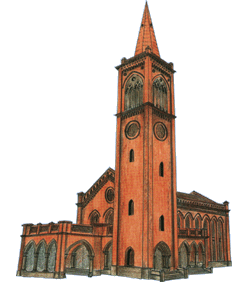
The synagogue was built 157 years ago and features a towering clock spire. The watchman tells us David Sassoon, who financed its construction, wanted the synagogue to be visible all across Pune, as indeed it was in its day.
The watchman himself is not Jewish, but has inherited the job of watchman from his father, and is clearly quite proud of the place. A Jew from Baghdad, David Sassoon was a major philanthropist, and built a hospital that stands to this day in Pune and bears his name. The mayor of Pune recently submitted a motion to remove the Sassoon name from the hospital and call it instead Dr. Ambedkar Hospital. The watchman tells us he had signed a petition protesting that initiative. My friend Kranti, though her family are followers of Dr. Ambedkar, tells him she too had written to protest that change. (The move was not particularly anti-Semitic, but rather part of a widespread move to rid Maharashtra of British names, and The mayor, when told of David Sassoon’s history, commented that she just thought he was British, and announced she was withdrawing her motion.)
Although Kranti has explained that I am a Buddhist nun from America, the watchman again whether I am Jewish, and it becomes clear that he would actually like to let us in. At last, he does, with a wave of his hand. We can walk around the grounds - but cannot enter the synagogue, he adds sternly.
We circle the synagogue. But for the stars of David, to my eye it looks an awful lot like a Gothic cathedral, right down to umatching ornamentation on the columns and long narrow stained glass windows.
As we come round the corner to return to the gate, we see a man and his wife enter on a scooter, and fear we may have gotten the watchman in trouble with our insistence. As we make for the gate, instead he calls us. The caretaker would like to meet us.
He opens the doorway, dons his yarmulke and invites us into the synagogue itself. We are inside an exquisitely detailed, almost understated synagogue in white marble with delicate, hand-painted trim, and all sense of Gothic cathedral disappears completely. The caretaker and his wife turn out to be long-standing members of the community and are most gracious in entertaining our questions. When I tell them I am from New York, his wife is full of questions about synagogues there. Are there really as many as she has heard? Do they offer Hebrew instruction? They are happy to answer our questions as well. The Jewish community in Pune now numbers 250 people, they tell us. Most are ‘Bagdadi’ Jews who migrated to India under British rule in the 18th century, but ten or so are Bene-Israel Jews, or Jews whose ancestors are said to have arrived in India before the destruction of the Second Temple in the first century of the common era. There had been several Jewish communities in Pune, but entire communities emigrated to Israel and now all the city’s Jews fit easily into this one space. They no longer use the separate section upstairs for women, but sit on opposite sides of the main floor during worship. All the high holidays are observed, as are services on the Sabbath, and weddings are still held in the synagogue itself. Rabbis visit, but none is resident, and there is no Hebrew instruction. Still, the foundation started by the Sassoon family continues with its charitable work, and now even has its own website - www.jacobsassoon.org - they tell us with some pride.
When it is time to leave, mindful of the watchman’s position, we make sure they know that he was very careful about letting us in, and did so only after long conversation. The caretaker tells us he used to open the synagogue for visitors for several hours one morning a week, but now will not even talk to journalists inquiring into the program. In 1990, in the opening days of the Gulf War, protestors broke into the synagogue and set fire to it. The Torah was burned, he tells us, with obvious distress. After that, they built the wall, and began to turn visitors away at the gate. Our visit ended, we return to that gate, and are treated to a broad grin from the watchman as we thank him and bid him goodbye.
Tuesday, June 06, 2006
from the text: there are other beings here too!
Despite what is reported in this blog, most of my time here is spent reading - reading a text that can be so dazzling in its narrative details that one easily overlooks any metaphorical readings. Here is my translation of a description of the moment that Buddha (then still just a bodhisattva) was conceived.
At that time, the earth trembled greatly, and the entire world was filled by a vast light, exceeding in its intensity the hues of the 33 gods. As a sun and moon in the darkest hells of the world: so great was this extraordinary appearance; so great was its power. This vast light filled even those places that were black with a blackening darkness that has not known the light of a sun or moon. The sentient beings born there had not seen even their own outstretched arms, but by this light they now saw one another. They said to one another, “Sirs, there are other beings here, too!” And so they came to know that there were other beings there too.
- Mūlasarvāstivāda Vinayavastu (Pravrajyāvastu)
This image itself is startling in its beauty, even without contemplating the implication that the experience of suddenly discovering that one is surrounded by others is being understood as one of the effects of the Buddha’s presence in the world.
Saturday, June 03, 2006


arranged marriages
A German friend here of mine who is also studying in Pune recently returned from a wedding of an Indian friend she had met in Europe, while he was there on an assignment.
The wedding was large. Very large. Some 2,500 guests were invited to the main event. A more intimate gathering of 500 people attending the remainder of the activities surrounding the wedding. There was also a special event for their Hindu guests, an affair attended by 500 of their Hindu friends who were feasted at a banquet hall featuring vegetarian food. Only the very closest 100 or so relatives and family friends would have the privilege of being hosted in and around the house itself, and would take their breakfast, lunch and dinner together at the house. During the five days of the wedding festivities, meals would be cooked, gifts would be given to guests and received in carefully prescribed patterns of exchange.
In short, there was much to be done. My German friend spent most of her time joining in the work with her host’s female relatives, as men and women live largely separate existences. One evening, she had some time to chat with her host, the groom. In Germany, when she had casually asked whether he had a girlfriend, he said yes, a girl in Mumbai, She now asked him whether the bride was that same girl. No, he said. It was the custom of his people to marry cross-cousin. He and his bride-to-be had known each other as children, but lived in villages some four hour’s bus ride apart. In any case, since girls and boys are segregated from the age of 15, they had not had any interaction in years. She had not seen him since then, though unbeknownst to her, he had paid a visit to her village to get a glimpse of her as the marriage negotiations advanced. The girl in Mumbai had not even been considered as a prospective bride. My German friend struggled with her reaction to that. She told me she recognized that her impulse to condemn what she saw as the lack of personal choice and human feeling in this arranging of marriages did not fit well with her observation that the women in the extended family seemed remarkably contented with their lives.
Attempting to help her understand the choices involved, her host said:
“You see how little time I have to spend with you here. Just a bit at the end of the day. It will be basically like that with my wife. The rest of the time, she is with the women of my family. She isn’t marrying me, actually. She is marrying my family. If my mother doesn’t like her, her life will be awful. And if she is not one of my cross-cousins, the rest of the village won’t accept here either, and her life here will be a hell. It wasn’t for myself that I didn’t marry my friend in Mumbai. It was for her. For her happiness.”
Later, when it was time for the bride to leave her childhood home and family to depart for the wedding and the home she would now share with her husband, the entire family wept bitterly. The family had actively arranged for this marriage, and yet they wept when their plan was at last executed. I imagine that at such moment, what my friend witnessed was a rare glimpse at the high value placed on this invisible web that held together that single household, and how highly valued was the sharing of all the small and quiet moments of that household’s life. When the moment came for the bride to leave home, even the men of her household were openly shedding tears, and visibly pained at her departure. My German friend asked them later why they wept so, since as the wife of a cross-cousin they would still see her and she would still be part of the extended family. “Yes,” they said, “We will see her. She will still be part of our family. But she is leaving our house.” She is leaving our house.
Thursday, June 01, 2006
the rains come
 Summer in my corner of India has been severe but swift, and ended overnight with the coming of the monsoon. The first drop of rain I had seen in the two months since I arrived in Pune came last Friday, the afternoon of the Khandoba puja (see May 27 blog entry). Pune had been remarkably green, given the utter absence of rainfall, but still it is dry. So much so, in fact, that clothes can be hung two or three shirts on top of another, and still be bone-dry in a few hours, if there is not enough space to hang them one by one, as can happen when Anna and I both have our laundry hanging on our veranda at the same time.
When this first bout of rain fell, it was not a major downpour, but it was certainly wet, and the temperature plummeted instantly. I was inside working at my desk, from time to time glancing out the window that lies directly before my desk, when I heard a rustling behind me. One of the young boys from the village behind the institute was huddled just inside my doorway. The roof of the veranda provides shelter from the rain, so there seemed no practical need for him to enter my room. As I turned to look at him, he smiled and gestured that he was there hiding from his playmates. He respectfully took off his sandals, set them down inside the door and returned to the urgent business of waiting for his friends to find him. He could barely suppress his giggling. I have two doors to my room, one letting into the main stairwell and the other letting out onto the veranda, and when the shout of his friends revealed that they had located him, he took off with a dash through the other door, leaving his sandals behind and saying, “Sorry, madam, ok?” as he crossed my room. Two of his friends tore through my room in mad and noisy pursuit, nearly knocking over my fan as they went. “Sorry, madam!” they shouted, leaving a thick trail of mud across my floor.
When the monsoon does not come, or comes in small measure, there are drought, famine... and desparate suffering. When the monsoon comes in its fulness, the fields are long with grain, the trees heavy with fruit. Even shorter term, the coming of the monsoon brings relief from the dry and dusty heat, and signals the season of growth, and green, and vibrant life. In fact, the exuberance of the young boys playing hide-and-seek in my room seems the most suitable response. But still this was not the monsoon, just a little pre-monsoon shower. The real rains came three days later, and when they did they snuck up on us in the dark of night.
I was awakened at about 1:30 am by bursts of lightning, puncturing the darkness with longer repetitions than I recall seeing anywhere else. The repeated lightning bolts were followed by long and continual rumblings of thunder, as if a plane were right just overhead, but hovering and not passing. The winds slammed my windows shut. They rattled and opened again from time to time, and I did not until then realize that they could not be latched properly. After a while I went back to sleep, until one particularly energetic burst of thunder roused me again. I counted the seconds from flash to thunder, and determined it was some 30 miles away. Still, the electrical outlets were clustered just above my head, so I got up and unplugged everything. I disconnected even my fan, which had been rendered unnecessary by the drop in temperature to a downright chilly 79 degrees. Again to sleep, and so it went until somehow my sleep was reluctantly penetrated by the recognition that the sound of rain falling was coming from inside my room. As I got up to investigate, my feet brushed a large wet spot at the end of the mattress. Apparently I was sleeping under one of several major leaks in the ceiling. By now, it was 4 am and quite tired. I simply shifted my bed out of harm’s way, took everything up off the floor, put a bucket under where I thought the main drip was, and went back to sleep, careful to rest my feet to the side of the wet spot.
The next morning, I awake, survey the damage and note that there are large watermarks fanning across my ceiling. With the monsoon’s persistent dampness, a generous spread of mold cannot be long away. I leave this room next week, but it is jarring nonetheless to recognize that my cozy little home has become virtually uninhabitable overnight.
Once I have fulfilled my duty to describe my disaster in detail and show the damage to all my neighbors and passersby, I take myself out for a walk. Dodging puddles and breathing in deep the cool morning air, I suddenly realize that the world now smells different. Fresh and full of earthy aromas, unidentifiable yet oddly familiar to me. The air is filled with hundreds of winged creatures I had never seen before, their four wings pale and lacy and yellow. Birds in clusters seem to have decided to all pay our garden a visit at the same time. The sky hangs low now with moody but delicate clouds, casting an oddly gentle light on this world of fresh new life. The monsoon has arrived in Pune.
Subscribe to:
Posts (Atom)
