the second year in india starts shortly. i fly back to delhi on oct 16 and will be in sarnath again by oct 19.
until the next blog entry, here is a short clip of a lama yeshe, my teacher's teacher, who passed away in the 1980s, sadly. very sadly.
Thursday, October 04, 2007


Friday, March 23, 2007
one year becomes two
although my time in india on the fulbright has come to an end, i will be back next fall (oct 2007) for another year on another grant, this time the aiis. in the meantime, i will be doing a far bit of travel:
after a short trip to portland, oregon to see my teacher and friends at maitripa institute...
i will be in redlands in southern california with my dear friend karen derris,
puerto rico at ganden shedrub ling,
madison for teachings during his holiness the dalai lama's visit to my home temple of deer park
new york with family,
tibet during the month of june on a monthlong site seminar organized by princeton to visit monastic sites from lhasa out past mount kailash to the kingdom of guge... and for more on that trip, you can visit the blog of that trip
germany in july for a conference on buddhist women and a week of teachings by his holiness the dalai lama,
tuscany in august for three weeks of teachings by a tibetan geshe on a commentary on the text i am working on for my dissertation,
mexico in september visiting some old friends at buddhist centers in the yucatan, xalapa and guadalajara
back to california in october to write grant applications and then a quick trip to portland to give a talk and visit friends at maitripa
all this takes place between now and the end of october. after that i will be back with more occasional postings from the year in india that became two...
after a short trip to portland, oregon to see my teacher and friends at maitripa institute...
i will be in redlands in southern california with my dear friend karen derris,
puerto rico at ganden shedrub ling,
madison for teachings during his holiness the dalai lama's visit to my home temple of deer park
new york with family,
tibet during the month of june on a monthlong site seminar organized by princeton to visit monastic sites from lhasa out past mount kailash to the kingdom of guge... and for more on that trip, you can visit the blog of that trip
germany in july for a conference on buddhist women and a week of teachings by his holiness the dalai lama,
tuscany in august for three weeks of teachings by a tibetan geshe on a commentary on the text i am working on for my dissertation,
mexico in september visiting some old friends at buddhist centers in the yucatan, xalapa and guadalajara
back to california in october to write grant applications and then a quick trip to portland to give a talk and visit friends at maitripa
all this takes place between now and the end of october. after that i will be back with more occasional postings from the year in india that became two...
to sarnath

towards the end of my time in india, i made my way back up to sarnath. there, i began reading the text in tibetan and continuing to work in the sanskrit with Dr. S. Bahulkar, a deeply respected scholar from pune and wonderful human being, working for the next year or so in the research department at the 'tibetan university' in sarnath. here i am with sonam, a student at the university and a regular conversation partner for me.
Sunday, October 15, 2006
street scenes
 My existence here takes place indoors, at my desk, surrounded by texts and Sanskrit and Tibetan dictionaries. But community life... life around me goes on outdoors, definitively and consistently outdoors.
Here are some very short clips to share with you a fuller sense of the sights and especially sounds of life, as it takes place on the street outside my apartment. They were all shot from my front balcony. Nothing dramatic, but very much embedded in the texture of life here.
Make sure you have your volume up for the Rickshaw clip. Its distinctive sound is spot on. The music you hear briefly is the sound that all vehicles play when they are backing up. Not all play that same enchanting tune, but they are equally, umm, catchy. The man is milking the water buffalo to bring to the hostel I used to take my meals from, two doors down from where I now stay. Click here to watch "Rickshaw Passes Below Balcony" This link will take you to youtube.com. Press 'back' on your browser to return to this blog.
Another sound that regularly punctuates my studying is that of street vendors calling out their wares. Here is a vegetable seller out looking for customers, door-to-door. His voice is so forceful, he even gets the buffalos' attention. In about the 8th or 9th second of the clip, he passes one of the fabulous designs that housewives draw in chalk daily in front of their homes. Click here to watch "Vegetable Seller Comes Round"
In Recycling, one of the many people who come by looking for garbage that can be recycled stands below the balcony sorting, as various people stroll by. What he leaves behind will be consumed by the dogs at night. Or left to compost slowly by the side of the road. That odd sound you hear towards the end is indeed the bellow of a water buffalo. Click here to watch "Recycling, the Hard Way"
Finally, here is a very quick glimpse of a wandering ascetic on almsround. Most every city or town of any size in India will have a fair number of people who have opted for a spiritual path that involves begging for alms, as Buddhist monastics here traditionally did. Click here to watch "Holy Man on Almsround" The orange clothes, the begging bowl, the gong to announce his presence, are all hallmarks of the wandering ascetic. That house seems to be particularly generous and/or pious, as all the wandering ascetics and flower sellers stop there and wait plenty of time before they give up, as this man does. People come through the neighborhood regularly hawking fresh flowers, which are offered daily at household shrines in many homes.
Saturday, October 14, 2006
monasteries made of stone: the movie
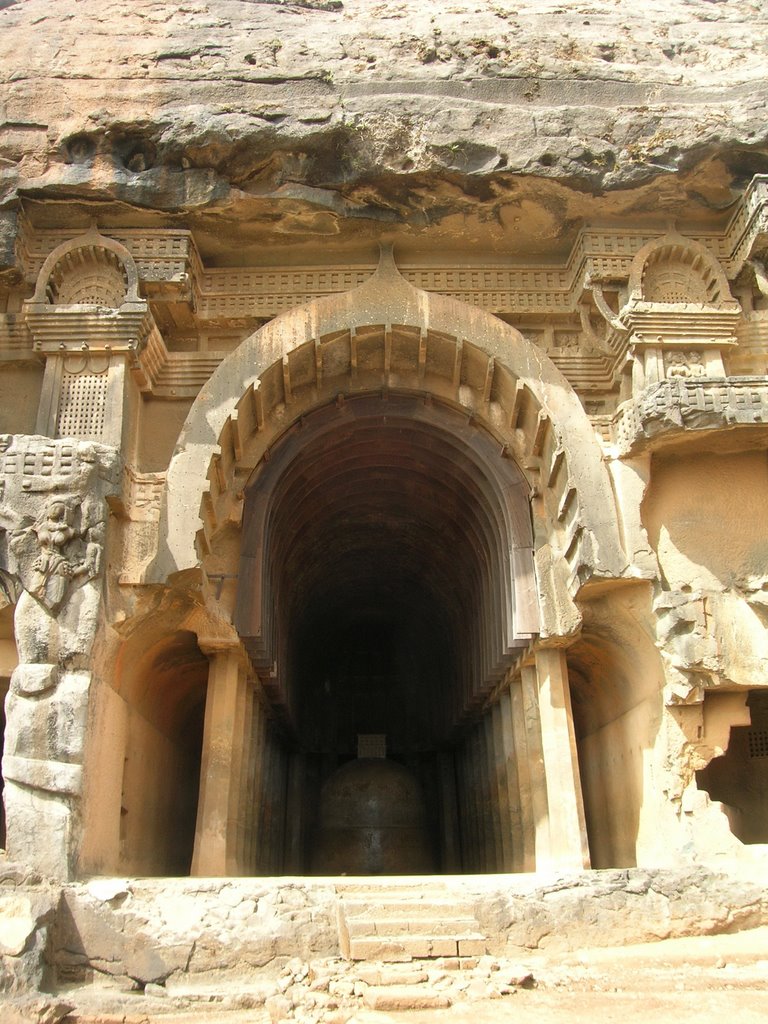 When visiting the Buddhist caves at Bhaja last June, my friend and fellow Fulbrighter Neil Dalal shot some video footage of the caves.
 Have a look at the caves in action, as it were. Not much in the way of audio, sorry to say.
And no, this is not just déjà-vu. You did, indeed, read about this before. It's in the June archive, under the 'monasteries built in stone' entry. But I have only now discovered youtube.com, unbelievable as that may be to some. (Thanks for the schooling, Chris!) So better late than never, I guess. I'll change the date of this blog entry back to June at some point, but for now, it's 'new.'
Friday, October 13, 2006
south indian breakfast: coconut-and-mango-chutney and spicy cream of wheat
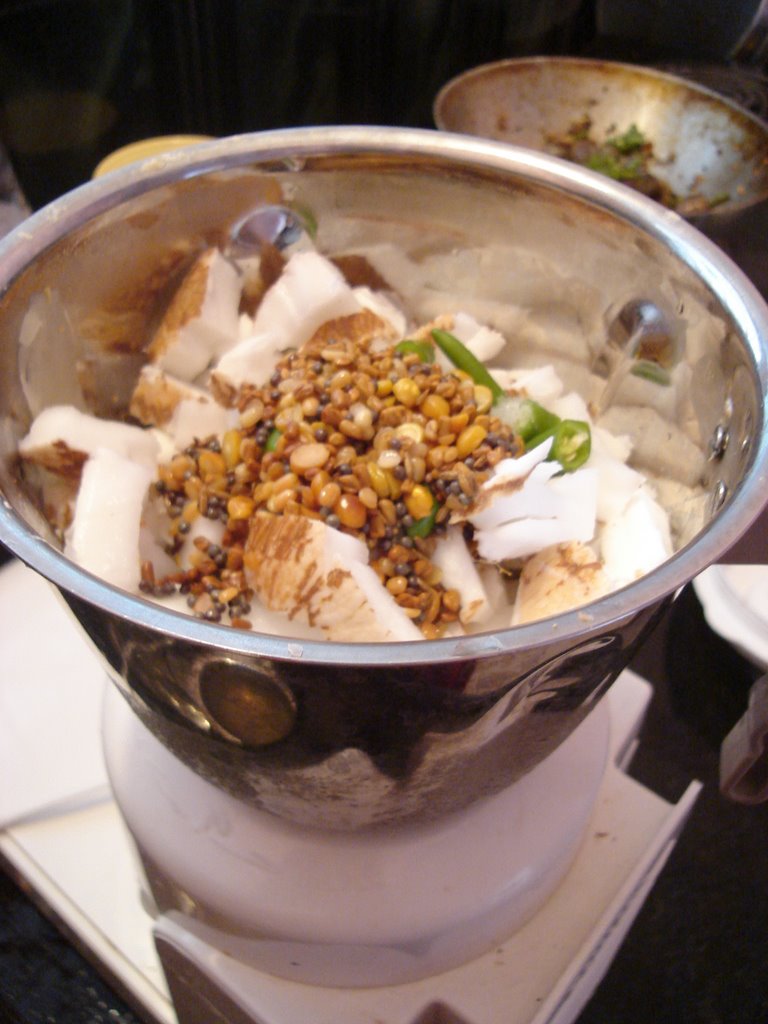 Some time back I promised recipes of some of the dishes my Sanskrit teacher has been showing me how to cook. It is an interesting process of teaching. He is an orthodox brahmin and thus will not touch food cooked by anyone except brahmins. So he tells me what to do, and I follow his instructions. So far, so good. But many of the dishes are things I have never tasted myself, and since he never samples anything to give me feedback, I just make it to my own taste and call it a meal. Of course, you'll be doing the same if you try it.. Anyway, here are recipes for two dishes I think are both 1) fabulous and 2) possible to cook with ingredients found in your local Asian market. And they go together. And, they are things I have actually tasted before, so I know it comes out the way it is supposed to.
Coconut and Mango Chutney
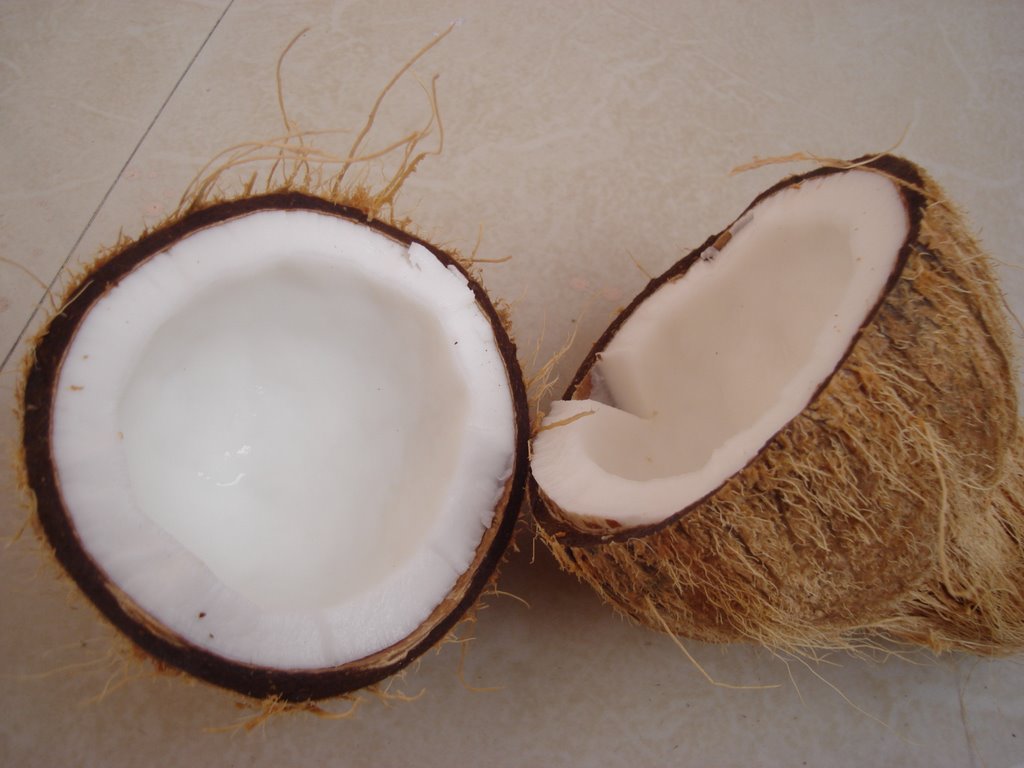
You need: a whole coconut; a green mango - not ripe, green; fenugreek seeds; mustards seeds; green chilies; turmeric poweder and salt. Asafoetida if you have it. Oh, and a food processor.
Heat oil a bit but don’t let it get too hot. Throw in a good teaspooon (my teacher here calls it a 'respectable amount' of) fenugreek and mustard seeds. Fry them and when mustard seeds just start to pop, take it off the heat. Let it cool a bit but not all the way. break up red chilies, add a dash of asafoetida (don't worry if you don;t have this.) Chop up a big peeled green mango into small pieces and chopped up meat of one coconut. add turmeric and salt. Eat with rice, with upama, with whatever you like, but eat it soon, it stays good only a couple of days. This is a kind of condiment.
Upama (A Kind of Spicy Cream of Wheat)
For this you need: cream of wheat; a green chili or two; cumin seeds; mustards seeds, urad dal (Indian shops will have it, don't worry); and salt. Asafoetida but only if you have it. This recipe is for one portion, so multiply as needed.
In a generous amount of oil (maybe four teaspoons), fry equal amounts of mustard seeds, cumin seeds, and urad dal. When it starts to turn brown, add a green chili or two depending on your tolerance for heat, and a dash of asafoetida. As soon as the green chili is in the pot, add about a cup of water, maybe three or four times the amount of cream of wheat you will be using. Bring to a boil and add two good pinches of salt. When it has hit a rolling boil, take about a quarter cup of cream of wheat and slowly add t in a steady stream, mixing continuously to avoid clumping. Reduce the heat, cover and let simmer for a couple of minutes. Not too long. Then mix once just turning it over, so what was on the bottom comes to the top and vice versa. Let it sit again, covered, for another minute or two. Then you are ready to eat. Be sure to eat it while it's piping hot. Much better that way.
 You can also make this with cashews. Use only raw, not roasted. You drop them in after the mustard, cumin and urda dal is brown and right before the green chilies. Then just stir once or twice until the color of the cashews begins to change. Then add chilies, water and continue from there.
Eat this with the coconut and mango chutney, and you will be having a typical Andhra breakfast!
Thursday, October 12, 2006
chinese soldiers fire, tibetans fall
Apparently, my karma to learn about youtube.com was due to ripen one way or the other. I still thank my friend Christine for first directing me to it, but a few hours after being introduced to this video service, I received an email with a link to this disturbing, though not surprising video footage of Chinese soldiers picking off Tibetan refugees in the Himalayas.
Without warning, and from a safe distance on a nearby ridge, Chinese soldiers take pot shots at Tibetans filing across an exposed stretch of snow. They hit two, the refugees continue trudging forward looking to pass the summit and find cover, perhaps too stunned and exhausted from the altitude and the physical exertion of crossing the Himalayas on foot to even break into a full run. As one utterly terrified Tibetan hides in the toilet of the Western climbers who shot the footage, the Chinese soldiers relax in the camp, smoking cigarettes, as if they have simply completed a little target practice.
In the ongoing disregard for life and truth that is a hallmark of totalitarian regimes everywhere, the Chinese government-controlled news agency later says the soliders had been 'forced to defend themselves' when they were attacked by refugees. Had this footage not emerged, it is highly unlikely the Chinese authorities would have bothered to make public mention of the incident at all. As long as the Chinese marketplace continues to beckon Western corporations, it is unlikely any other authorities will say much of anything at all.
In a clear sign of the desperation of the situation in Tibet, among the 20 prisoners the soldiers captured after killing two were seven children. No one fleeing for reasons of economic opportunity or political conscience exposes their children in this way to the elements - and to Chinese brutality, unless things are even worse at home.
Without warning, and from a safe distance on a nearby ridge, Chinese soldiers take pot shots at Tibetans filing across an exposed stretch of snow. They hit two, the refugees continue trudging forward looking to pass the summit and find cover, perhaps too stunned and exhausted from the altitude and the physical exertion of crossing the Himalayas on foot to even break into a full run. As one utterly terrified Tibetan hides in the toilet of the Western climbers who shot the footage, the Chinese soldiers relax in the camp, smoking cigarettes, as if they have simply completed a little target practice.
In the ongoing disregard for life and truth that is a hallmark of totalitarian regimes everywhere, the Chinese government-controlled news agency later says the soliders had been 'forced to defend themselves' when they were attacked by refugees. Had this footage not emerged, it is highly unlikely the Chinese authorities would have bothered to make public mention of the incident at all. As long as the Chinese marketplace continues to beckon Western corporations, it is unlikely any other authorities will say much of anything at all.
In a clear sign of the desperation of the situation in Tibet, among the 20 prisoners the soldiers captured after killing two were seven children. No one fleeing for reasons of economic opportunity or political conscience exposes their children in this way to the elements - and to Chinese brutality, unless things are even worse at home.
wedding, part one: going to kashi
 At both of the south Indian weddings I attended this past summer, the groom symbolically passed through the major stages of life before arriving at the householder stage, when the actual wedding takes place. Both weddings were brahmin families, and among the ideal life stages for brahmin males is the scholar phase, when students graduate their basic Vedic studies and go to Varanasi (known by its ancient name of Kashi) for advanced studies. First the groom ritually concludes his student stage (brahmacarin) during the wedding rituals, even if he never actually upheld any of the practices of that stage. The groom is welcomed 'home' from his studies, and then, symbolically outfitted for the journey to Varanasi, where advanced scholarly studies is best pursued. The groom and his party exit the wedding hall, and are then stopped by the bride's brother, who stops him and convinces him to stay and get married instead.
 This ritual was particularly poignant in the case of this groom, because he did in fact wish to pursue advanced Vedic studies, but had to abandon them after a family financial crisis put pressure on him to study engineering instead. In this video, the groom's relatives are escorting him out of the wedding hall. He wears traditional wooden sandals, carries an umbrella, a water pot, a bundle of food and ritual implements. The man in white in front is the priest (purohita) and the one following is the groom's father. Watch the groom "Leave for Kashi."
Once outside, several members of the bride's party accost the groom and beseech him to abandon his plans to travel to Kashi. My friend Neil Dalal tells me he was in a wedding once as a friend of the groom and his job was to 'try to convince' the groom to turn down the invitation to stay and marry. Here, after repairing the sandal that fell apart and came off the groom's foot (view this clip), the bride's family addresses him with great respect, worship him with lights, incense and flowers as if he were a god, and offer him gifts of food and clothing, carried on silver platters by women you can see behind and beside the groom. In this clip, the bride's brother honors him with a great mark of respectful hospitality, by washing his feet. View this clip. You'll note see that many of those involved are laughing, perhaps at their own role-playing, for these are enactments of roles that almost no one manages to actually live anymore.
More coming in this wedding series...
Tuesday, October 03, 2006
where is visakhapatnam, anyway?
First, a warm thanks to those of you who even attempt to pronounce the name of the place I'm staying: Visakhapatnam. Especially my mom. She always pauses for a moment before she says it, and then really nails the pronunciation. It's as if she has written it down and is reading it from a paper she keeps nearby when she calls. Actually, as I think about it, I'm sure that's exactly what she's doing. She's very careful about that sort of thing. (If you care to try yourself, it is, more or less: Vi - SHOCK - uh - putt - numb).
But even those who can pronounce it well cannot usually locate it. Visakhapatnam is very much south India culturally (language is Dravidian, etc.) but geographically on the northern end of what qualifies as 'south India.' I usually explain that I am on the east coast, right on the coast, and about halfway down the subcontinent. And then I explain it again a few weeks later. So here is a satellite image marking the spot.
Visakhapatnam, India - private house map - Tagzania
If the map above does not load properly, try going to this link:
Click here to view Vi - SHOCK - uh - putt - numb.
You can zoom in and out with the arrows on the side of the map. You can also drag the map around to see what else is nearby. (The minorly famous 'Kailasagiri' or 'Mount Kailash' of the south is a short mile to the north, more mountains inland Mount Kailash, the beach you see off to the right is about a quarter mile, or a five minute walk, from here.)
But even those who can pronounce it well cannot usually locate it. Visakhapatnam is very much south India culturally (language is Dravidian, etc.) but geographically on the northern end of what qualifies as 'south India.' I usually explain that I am on the east coast, right on the coast, and about halfway down the subcontinent. And then I explain it again a few weeks later. So here is a satellite image marking the spot.
Visakhapatnam, India - private house map - Tagzania
If the map above does not load properly, try going to this link:
Click here to view Vi - SHOCK - uh - putt - numb.
You can zoom in and out with the arrows on the side of the map. You can also drag the map around to see what else is nearby. (The minorly famous 'Kailasagiri' or 'Mount Kailash' of the south is a short mile to the north, more mountains inland Mount Kailash, the beach you see off to the right is about a quarter mile, or a five minute walk, from here.)
Saturday, September 30, 2006
coffee down south, not chai
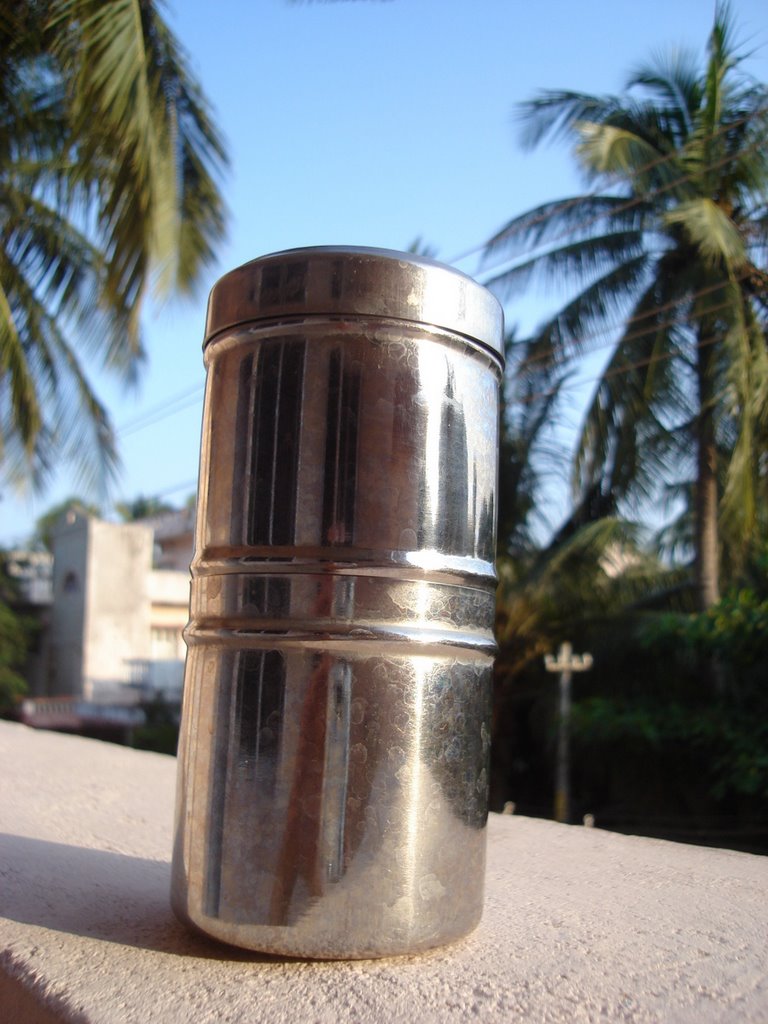 There are many serious cultural differences between south and north India. To my mind, the most profound is: coffee. In the north, it's chai. Here, it's coffee. Happily.
 I can date with some precision the beginning of my interest in the issue of coffee drinking in India. Before coming to India, I spent several months with my dear friends Karen Derris and Ed Murphy, as I waited for the Fulbright to secure Indian research visas for its scholars. To call Ed a coffee drinker would be woefully inadequate. In fact, Ed has his coffee beans flown in from his favored plantations in Nicaragua and other such places and grinds the beans seconds before brewing his coffee. Coffee in their home was readily available, and Ed was very concerned as to how I would have continued access to coffee once in India. I planned to be in the north where tea (or ‘chai’) is everywhere and coffee nowhere. At one point, Ed was advocating that I learn how to roast my own beans, as unroasted beans keep longer and could be shipped to me green from time to time. I dragged my feet a bit there, and explained that anyway, I take milk in my coffee. Milk means refrigeration, but in Sarnath where I then expected to spend most of my time, there are scheduled power outages from 9 am to 5 pm daily. This led Ed to propose other solutions for me. The suggestions he pitched ranged from carrying a generator with me to India (um, that might be a bit heavy, no?) to procuring a Lister Engine (a what?). In the end, he sent me off to India with a handy one-cup gold filter.
When I first arrived here, I was traveling with my good friend Chela, who is Cuban, as long as we are speaking of avid coffee drinkers…. Chela bought five kilos of excellent coffee at a little shop we found in Delhi. We begged hot water here and there, and used my handy filter to brew ourselves some fine cups of coffee during the month we were together. Some fine cups, yes, but certainly not five kilos’ worth. She carried those bags of coffee with her around the country until she left, and then willed it to me.
But all this was before I knew I’d be in south India, where coffee is very much the caffeinated beverage of choice, taken with warmed milk and, usually, sugar. Which brings me to the supposed point of this blog entry: The material culture of coffee-making in the south.
 What you see pictured here is a ‘coffee filter’ a $2 kitchen appliance in the stainless steel that is a staple of Indian kitchen (see the coffee cups as well.) This beautifully simple technology is all you need to make a fine cup of strong coffee. The coffee beans are ground to a fine powder, finer than we might grind for espresso makers, and this powder is then placed in the top half of the coffee maker.
 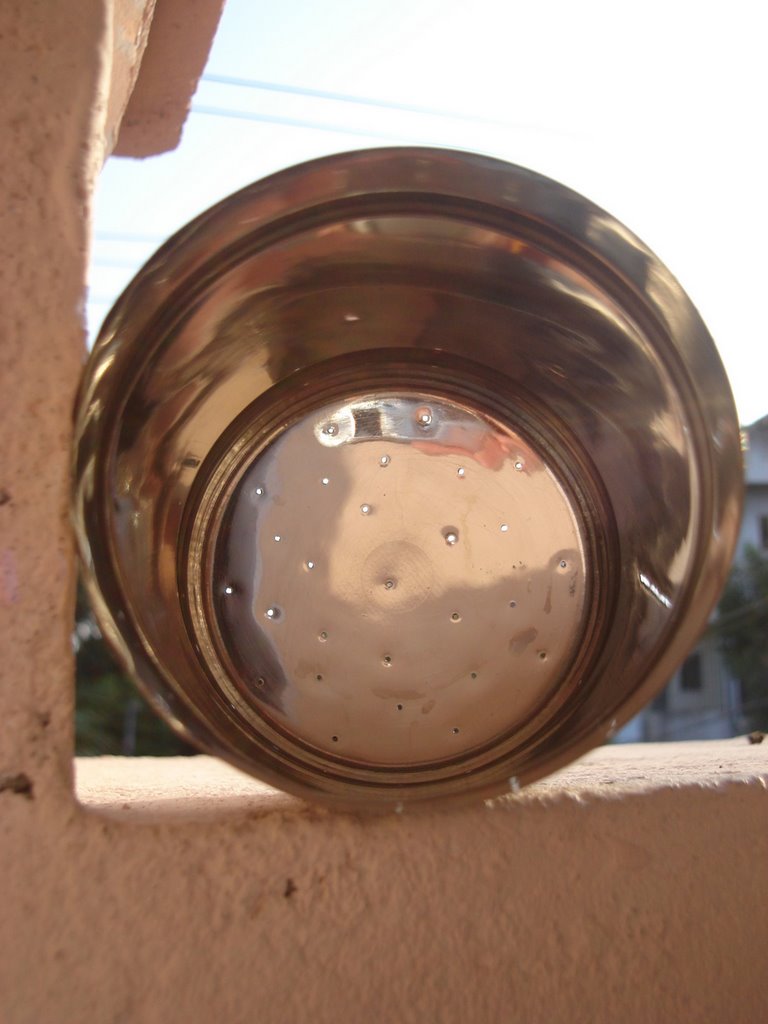 As you see, the holes are tiny, and to compound matters, the other device you see is placed on top of the coffee powder in the filter to tamp it down. On top of that goes boiling water, and then it is covered to allow it to drip down. The first time I tried it, I thought I was doing something wrong, as it took so long to drip down that the coffee had begin to cool off. No, I was told, that is why the milk needs to be very, very hot.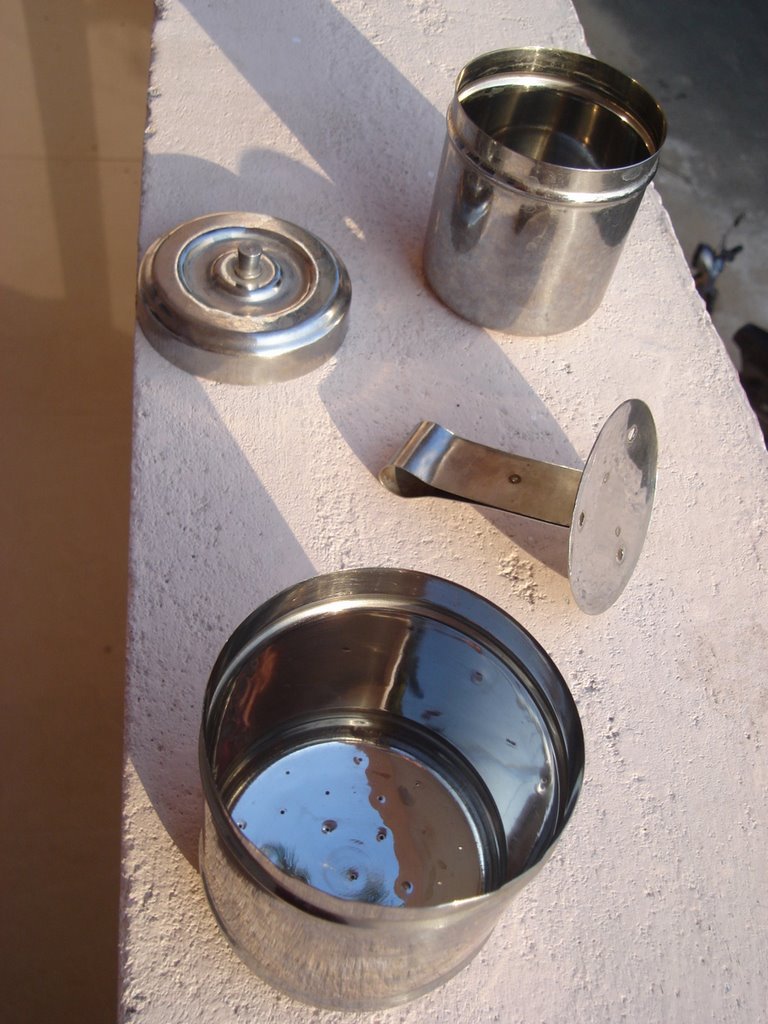
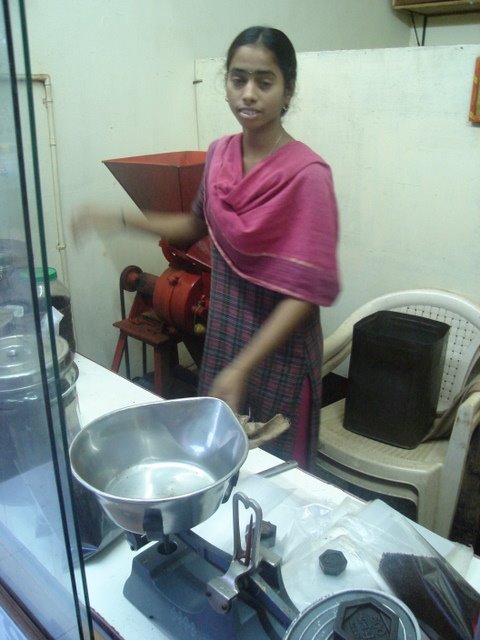
Have you begun yet to wonder why a Buddhist nun is devoting an entire blog entry to coffee? After I first ordained, my youngest brother Dan said, “So now you’ll have to give up coffee, right?” Dan was much more health-conscious than I, never drank coffee or caffeinated tea himself and was clearly pleased at the prospect of my giving up coffee. I was equally pleased to tell him that in fact, Buddhist monks in Japan are sometimes credited with discovering green tea, which they valued greatly for its benefits in supporting alertness during long meditation sessions. Whether or not this is so, the fact remains that Buddhist monastics take no vow against consuming caffeine. Alcohol? Definitely off-limits. Coffee? Coming right up…how do you take it?
Vow or not, coffee is not among the objects we are expected to renounce. Of course, as with anything else, we must take great care not to allow ourselves to become dependent or emotionally attached to the objects we like, eagerly seeking them out and mourning their absence. … The point is not to deprive ourselves of all enjoyment, but to learn to enjoy without becoming attached to the object, or to the experience of it.
As committed Buddhist practitioners, what we strive to renounce is our attachment, not necessarily the objects of pleasure. The difference, you see, is in the mind.
Friday, September 08, 2006
welcoming a new baby: a naming ceremony
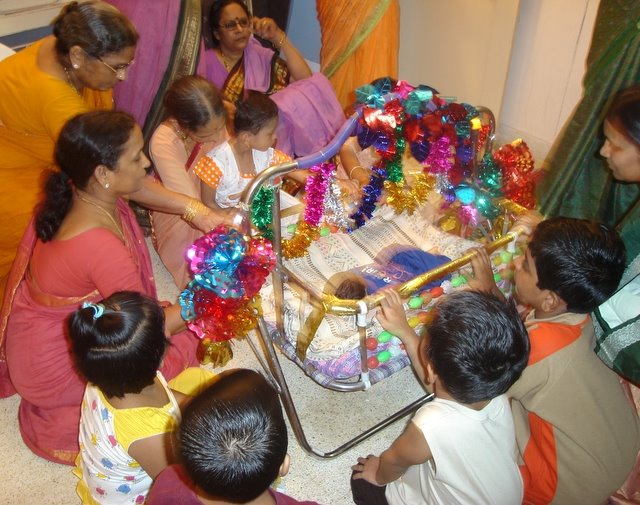 When it comes to life-cycle rituals, Hindu culture beats Buddhist culture (or at least Tibetan Buddhist culture), hands down. I attended my third one in two weeks, this time a ceremony to give a newborn child its name, called nāmakarma. Much more than announcing the name, this ritual is a sort of formal introduction of the child to his community, the extended family. Two quite beautiful practices put all the relatives in the role of caregiver to the child – first, men and women alike will have a chance to give the child milk and later rock the child to sleep, allowing all to share in these two central acts of motherly love.
 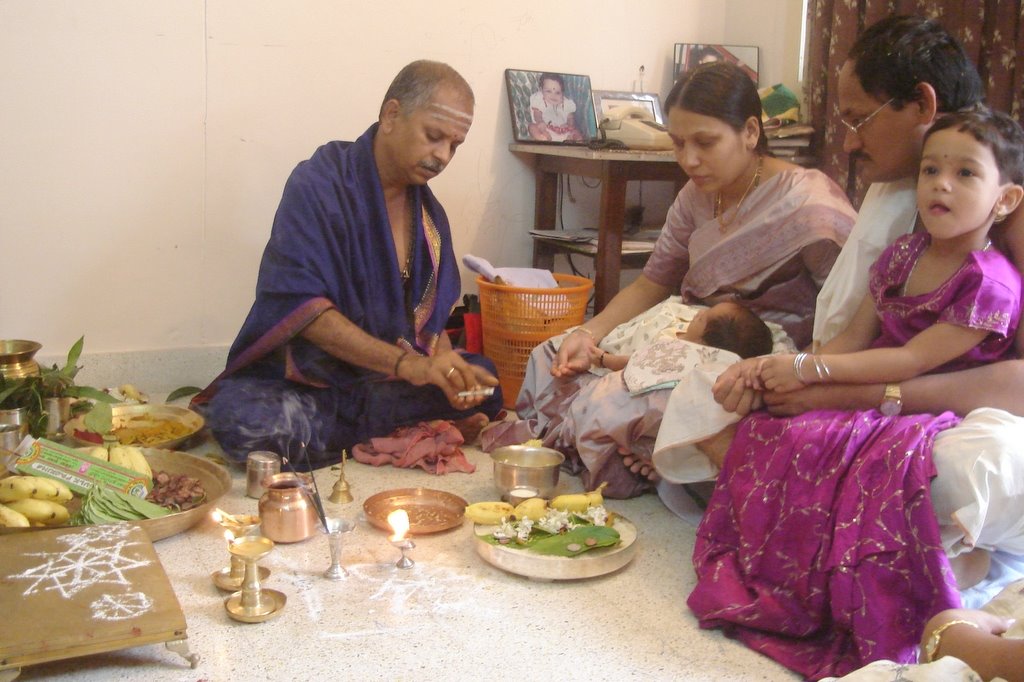 The overall ceremony begins with the offerings of flowers, rice and other substances to the gods and Vedic chanting that form a backbone a staple of these life-cycle rituals (see photo).
 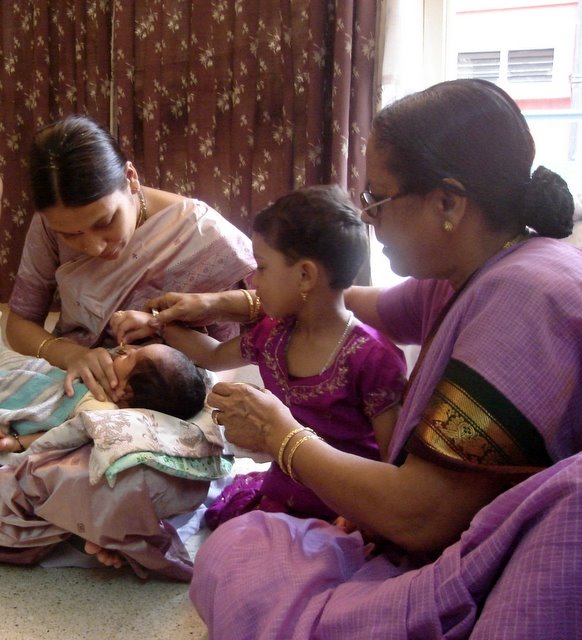 After this ritual is completed, each person scoops up a tiny bit of milk with one of the parents’ gold rings and gives a drop or two to the child (see photo). Later, the infant is placed in a cradle and everyone is invited to take a turn rocking the baby to sleep. As the child is being rocked, the women of the family gather to sing a lullaby (see photo, women singing in background.) Unlike the English lullaby in which the cradle is made to fall from a tree, this one tells the infant he or she is lying on the bedrock of the world, held up by the four Vedas and escorted by divine protectors.
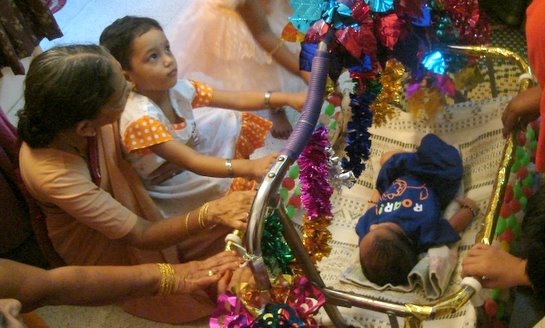
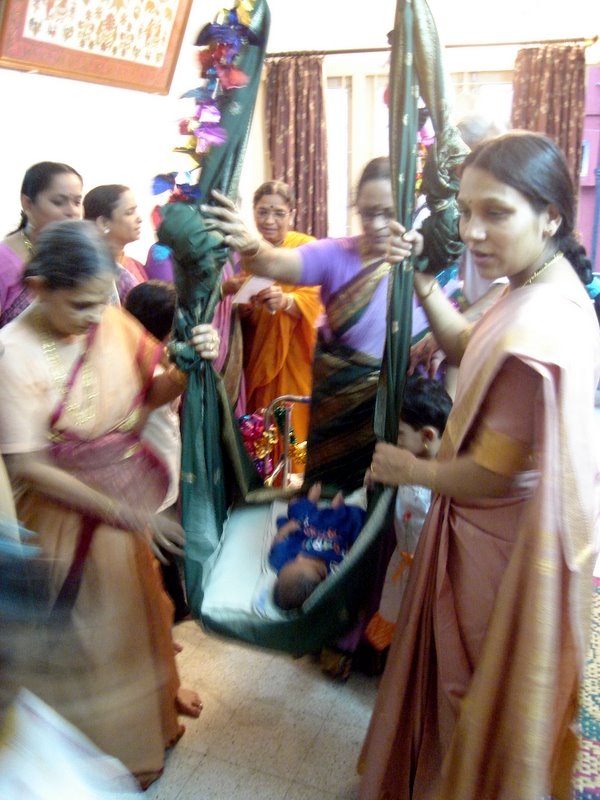 After the child has been rocked by the adults in the tradition cradle made of a cloth tied to the ceiling, it is placed in a cradle on the floor and children are invited to join in and help put the child to sleep. The infant’s older sibling has been very much included in each phase of the ritual, sitting on her parents’ laps even during the most complex stages of the ritual, feeding milk to her brother and now rocking him to sleep.
 Based on the astrological chart of the infant, this ceremony might also mark the first time that certain male relatives are permitted to see the child’s face, including even the father if the stars suggest he should not. In the case of the baby boy whose naming ritual I attended today, there had been no prohibitions against seeing his face earlier.
 Meanwhile, it is at this ceremony that the child’s name is first made public. At this ritual, the child was already three weeks old, but nearly everyone was hearing the child’s name for the first time, including grandparents and his older sister. Here it is the child’s father who decides the name, perhaps in consultation with relatives. In this case, the father had still been weighing options up to the last minute. The name is announced – Madhav Simha and much discussion breaks out as relatives state the name to one another and comment on the choice. The strongest comments come from the infant’s four-year old sister, who greets this proposal a scowl and a vigorous shake of the head. No, she insists, to much laughter, his name is ‘Tamuru’ - the local term for ‘Brother.’
Wednesday, September 06, 2006
moving into a big pink building
 Living in a ladies hostel is great, if you are a college freshman, or have very recently been one. Eating the hostel food is not great, no matter how dim one’s memories of home-cooked meals.
 That said, I am grateful for the opportunity to learn about the lives of the first generation of young Indian women for whom a college education in engineering or computer science is the obvious choice, virtually regardless of their caste. But now that it is clear I will be here for a while more, the idea of having my own place began to make sense. Very good sense.
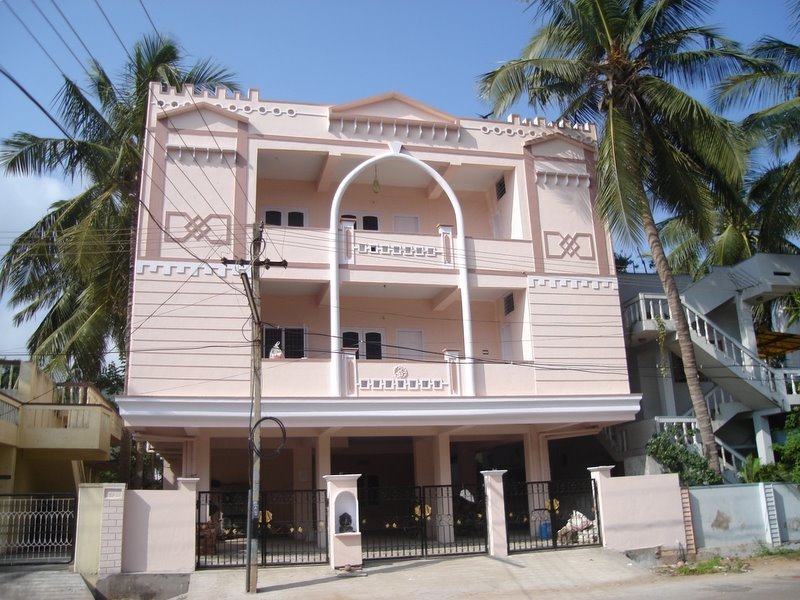 Last week, a ‘to let’ sign went up on a big pink building that has been under construction these past months, and within a few days, I had moved in. My new home is a brand new apartment with three bedrooms, three bathrooms, two balconies and excellent cross-breezes. I can see the sea from the rooftop. This is all serious overkill, definitely, but in fact it was the first apartment to come free within walking distance of my Sanskrit teacher’s home. And not only is it within walking distance, but literally across the street. From my front balcony I can look into my teacher’s front yard and see whether he is in or not. We signed a flexible short-term lease, and I will share this vast space with Sangeeta, who will be in and out of town as her research permits.
Did I mention the kitchen? Now to my Sanskrit classes I am adding lessons in cooking south Indian food, the one topic besides Sanskrit culture that I have seen my Sanskrit teacher generate real enthusiasm for. Recipes to follow…

Photos are of my workspace, of the view from my workspace out the door onto the front balcony and of the big pink building itself (our apartment is second floor in front).
Tuesday, September 05, 2006
“let us read” - on translating
My Sanskrit teacher Shastry Garu comments that when he was a boy in high school and eager to learn English, he used to go sometimes to hear Christian missionaries preach, since they were the only native English speakers in the area of Andhra Pradesh, in south India, where he lived. One very charismatic American preacher used to dance, weep and fall to the ground as he preached in English. Now, the missionaries always had a Telugu translator alongside them, and Shastry Garu notes that although he himself could not understand much of what the preacher said, he knew enough to tell that the translator understood even less. But when the American danced and threw his arms in the air as he preached in English, the translator too danced ecstatically as he spoke in Telugu. And when the preacher cried out and fell to the ground, so did the translator. This, Shastry Garu felt, was a valid translation, a translation of emotion. “The translator was not communicating the verbal argument. But the whole content of the speech was conveyed. It was a cogent display of inspiration and emotion,” Shastry Garu noted. “And it worked. It was a working translation.
“Translating each word into another language is not a valid translation. The meaning resides in the whole sentence, whole paragraph, sometimes in the book whole. “So when translating, Shastry Garu said, one should render entire sentences, not words. Translation should go from sentence to sentence. Even then, sometimes going from sentence to sentence is not enough. Sometimes you have to translate paragraph by paragraph to get the meaning into another language properly. Then too sometimes you have to concentrate on translating the emotion of a story. Sometimes that is the content. Changes will be necessitated by that. Then you are translating literature.
“You cannot go from word to word when you are translating. How does a language work? Each one has its own idiom. Idiomatic utterances are what convey meaning. A word alone does not. A word alone is not a valid unit of meaning…Let us read.”
The theory of translation that Shastry Garu is urging is deeply embedded in Sanskritic theories of language and of how meaning is generated. It is also very much at odds with the principles followed by many of the great scholars who translated Sanskrit texts into Tibetan, and of much translation by lesser beings of Tibetan into English. Including, to a far larger degree than Shastry Garu would accept, my own translation of the Sanghatasutra… I have some reflection to do.
“Translating each word into another language is not a valid translation. The meaning resides in the whole sentence, whole paragraph, sometimes in the book whole. “So when translating, Shastry Garu said, one should render entire sentences, not words. Translation should go from sentence to sentence. Even then, sometimes going from sentence to sentence is not enough. Sometimes you have to translate paragraph by paragraph to get the meaning into another language properly. Then too sometimes you have to concentrate on translating the emotion of a story. Sometimes that is the content. Changes will be necessitated by that. Then you are translating literature.
“You cannot go from word to word when you are translating. How does a language work? Each one has its own idiom. Idiomatic utterances are what convey meaning. A word alone does not. A word alone is not a valid unit of meaning…Let us read.”
The theory of translation that Shastry Garu is urging is deeply embedded in Sanskritic theories of language and of how meaning is generated. It is also very much at odds with the principles followed by many of the great scholars who translated Sanskrit texts into Tibetan, and of much translation by lesser beings of Tibetan into English. Including, to a far larger degree than Shastry Garu would accept, my own translation of the Sanghatasutra… I have some reflection to do.
Saturday, September 02, 2006
answering the call: cell phone use during rituals
 Social life just will not be put on hold, it seems, even during major rituals here. Over the last couple of weeks, I have attended three important rituals, marking the naming of a child and marriages. The families involved were fairly orthodox brahmins, and had chosen their ritual officiants (or purohita) with care, to ensure that all stages of the ritual were performed thoroughly and correctly. Nevertheless, when the ritual officiants’ cell phone rang during the ceremony, they did not hesitate to answer the call. At both weddings I attended, the grooms also took calls on their cell phones as the wedding ceremony went on, but sadly not while my camera was at hand.
 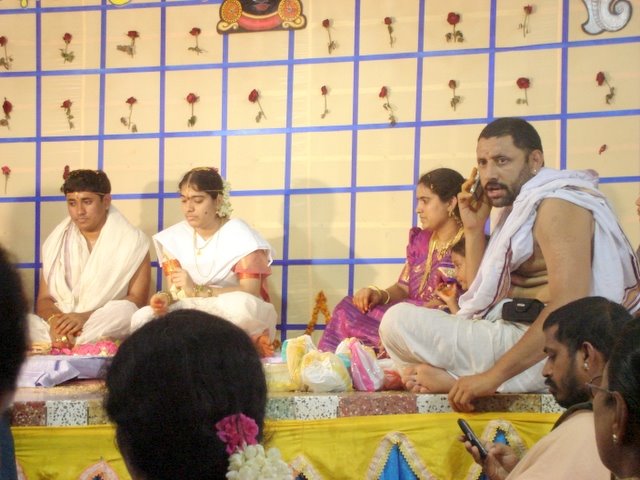 If the use of cell phones is any indication, these life-cycle rituals do not interrupt ordinary life, but absorb it, even as they punctuate and transform it. At no time did those talking on their phones while they participated in the ritual appear embarrassed or offer an apology. Nor did I see anyone exchange disapproving glances. Indeed, the only people who seemed to find this noteworthy were my friends Sangeeta, Ma’ayan and I, all three of us students of Indian religions, with all the apparently false assumptions about solemnity of rituals that entails.
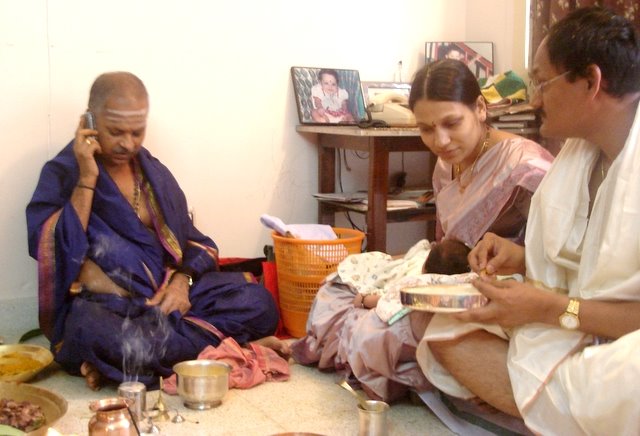 The accompanying photos are taken at a wedding and at a naming ceremony, hosted by two different families in two different cities. In each case, the person on the phone is a central participant in the ritual.
Tuesday, August 08, 2006
hitting the road
So August is a big time for weddings here (yes, those would be ‘monsoon weddings’) and my teacher has invited Sangeeta and me to attend one near his native village, about half a day’s journey from here. The village is in the general area of Amaravati, one of the earliest remaining Buddhist stupas, and the site of a Kalachakra initiation for world peace by His Holiness the Dalai Lama earlier this year. After the weddings, we will visit Amaravati, and another monastery carved into a mountain, in which the great Buddhist logician Dignāga lived.
Expect to be back in Visakhapatnam, and back online, on the 14th or 15th.
Expect to be back in Visakhapatnam, and back online, on the 14th or 15th.
Subscribe to:
Posts (Atom)

