Saturday, September 30, 2006

coffee down south, not chai

There are many serious cultural differences between south and north India. To my mind, the most profound is: coffee. In the north, it's chai. Here, it's coffee. Happily.

I can date with some precision the beginning of my interest in the issue of coffee drinking in India. Before coming to India, I spent several months with my dear friends Karen Derris and Ed Murphy, as I waited for the Fulbright to secure Indian research visas for its scholars. To call Ed a coffee drinker would be woefully inadequate. In fact, Ed has his coffee beans flown in from his favored plantations in Nicaragua and other such places and grinds the beans seconds before brewing his coffee. Coffee in their home was readily available, and Ed was very concerned as to how I would have continued access to coffee once in India. I planned to be in the north where tea (or ‘chai’) is everywhere and coffee nowhere. At one point, Ed was advocating that I learn how to roast my own beans, as unroasted beans keep longer and could be shipped to me green from time to time. I dragged my feet a bit there, and explained that anyway, I take milk in my coffee. Milk means refrigeration, but in Sarnath where I then expected to spend most of my time, there are scheduled power outages from 9 am to 5 pm daily. This led Ed to propose other solutions for me. The suggestions he pitched ranged from carrying a generator with me to India (um, that might be a bit heavy, no?) to procuring a Lister Engine (a what?). In the end, he sent me off to India with a handy one-cup gold filter.

When I first arrived here, I was traveling with my good friend Chela, who is Cuban, as long as we are speaking of avid coffee drinkers…. Chela bought five kilos of excellent coffee at a little shop we found in Delhi. We begged hot water here and there, and used my handy filter to brew ourselves some fine cups of coffee during the month we were together. Some fine cups, yes, but certainly not five kilos’ worth. She carried those bags of coffee with her around the country until she left, and then willed it to me.

But all this was before I knew I’d be in south India, where coffee is very much the caffeinated beverage of choice, taken with warmed milk and, usually, sugar. Which brings me to the supposed point of this blog entry: The material culture of coffee-making in the south.

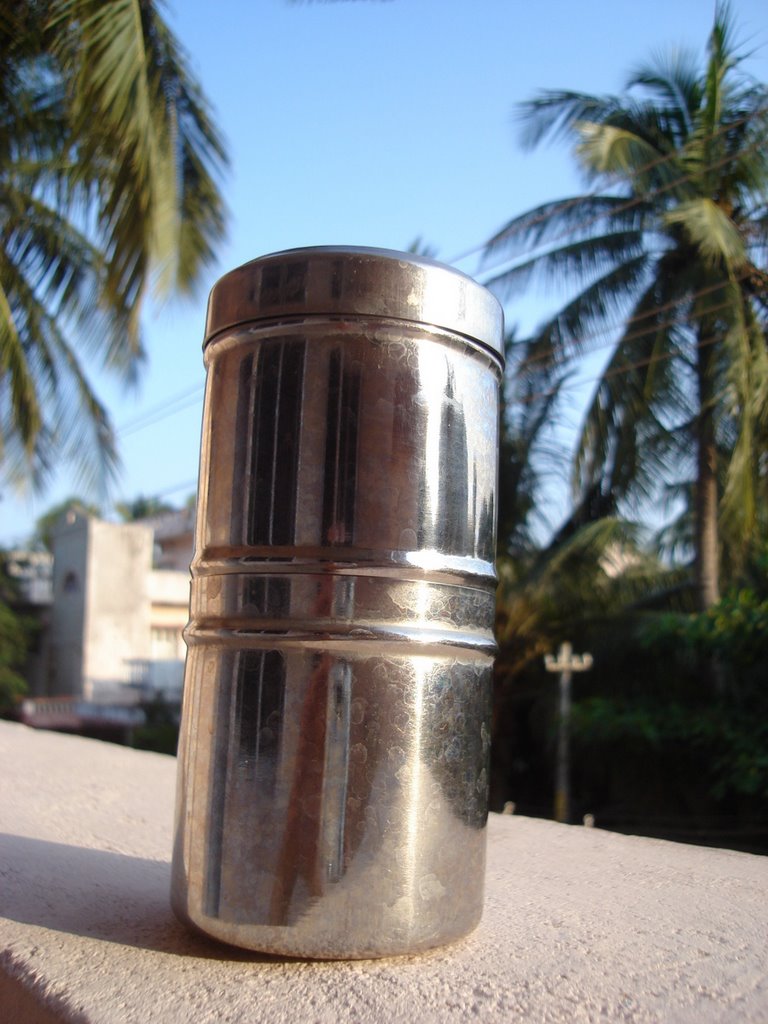
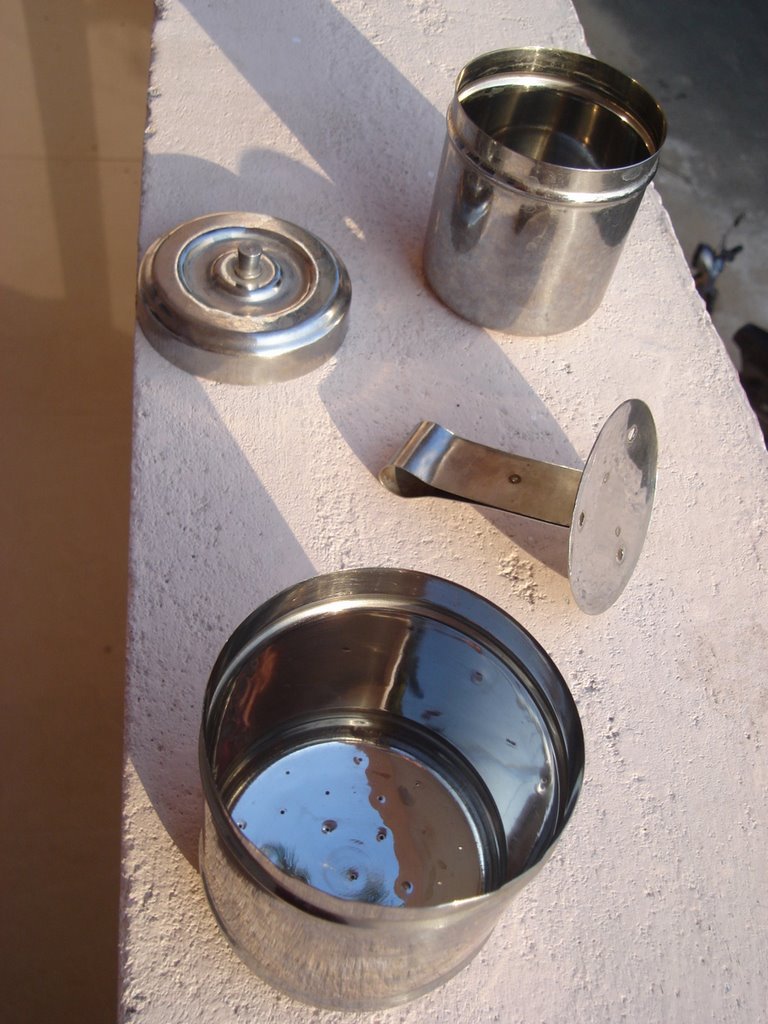
What you see pictured here is a ‘coffee filter’ a $2 kitchen appliance in the stainless steel that is a staple of Indian kitchen (see the coffee cups as well.) This beautifully simple technology is all you need to make a fine cup of strong coffee. The coffee beans are ground to a fine powder, finer than we might grind for espresso makers, and this powder is then placed in the top half of the coffee maker.

As you see, the holes are tiny, and to compound matters, the other device you see is placed on top of the coffee powder in the filter to tamp it down. On top of that goes boiling water, and then it is covered to allow it to drip down. The first time I tried it, I thought I was doing something wrong, as it took so long to drip down that the coffee had begin to cool off. No, I was told, that is why the milk needs to be very, very hot.

Have you begun yet to wonder why a Buddhist nun is devoting an entire blog entry to coffee? After I first ordained, my youngest brother Dan said, “So now you’ll have to give up coffee, right?” Dan was much more health-conscious than I, never drank coffee or caffeinated tea himself and was clearly pleased at the prospect of my giving up coffee. I was equally pleased to tell him that in fact, Buddhist monks in Japan are sometimes credited with discovering green tea, which they valued greatly for its benefits in supporting alertness during long meditation sessions. Whether or not this is so, the fact remains that Buddhist monastics take no vow against consuming caffeine. Alcohol? Definitely off-limits. Coffee? Coming right up…how do you take it?

Vow or not, coffee is not among the objects we are expected to renounce. Of course, as with anything else, we must take great care not to allow ourselves to become dependent or emotionally attached to the objects we like, eagerly seeking them out and mourning their absence. … The point is not to deprive ourselves of all enjoyment, but to learn to enjoy without becoming attached to the object, or to the experience of it.

As committed Buddhist practitioners, what we strive to renounce is our attachment, not necessarily the objects of pleasure. The difference, you see, is in the mind.

Friday, September 08, 2006

welcoming a new baby: a naming ceremony

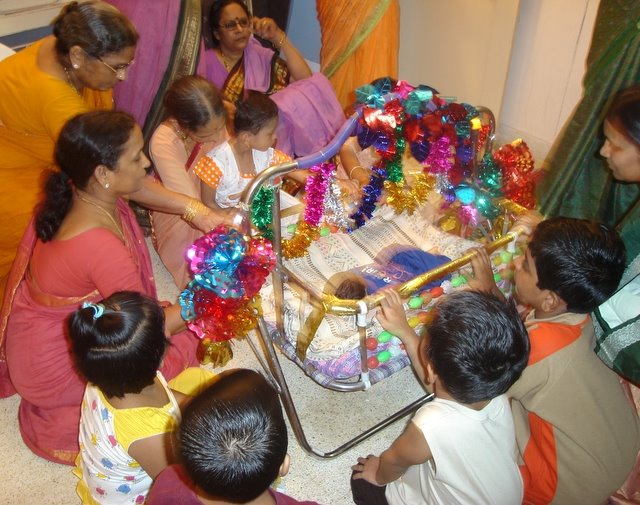
When it comes to life-cycle rituals, Hindu culture beats Buddhist culture (or at least Tibetan Buddhist culture), hands down. I attended my third one in two weeks, this time a ceremony to give a newborn child its name, called nāmakarma. Much more than announcing the name, this ritual is a sort of formal introduction of the child to his community, the extended family. Two quite beautiful practices put all the relatives in the role of caregiver to the child – first, men and women alike will have a chance to give the child milk and later rock the child to sleep, allowing all to share in these two central acts of motherly love.

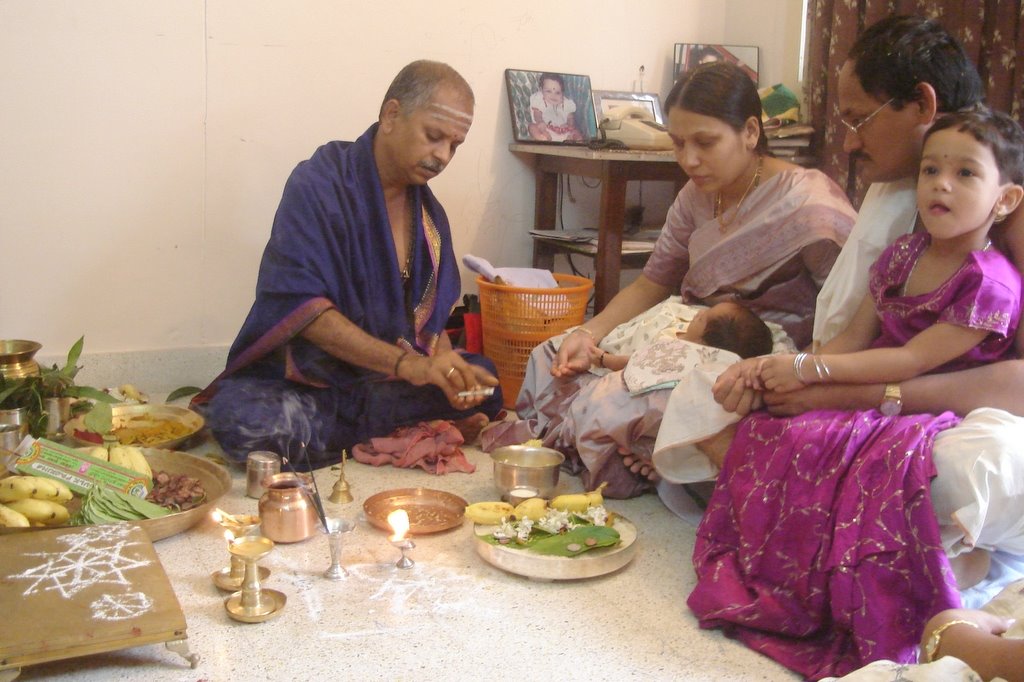
The overall ceremony begins with the offerings of flowers, rice and other substances to the gods and Vedic chanting that form a backbone a staple of these life-cycle rituals (see photo).

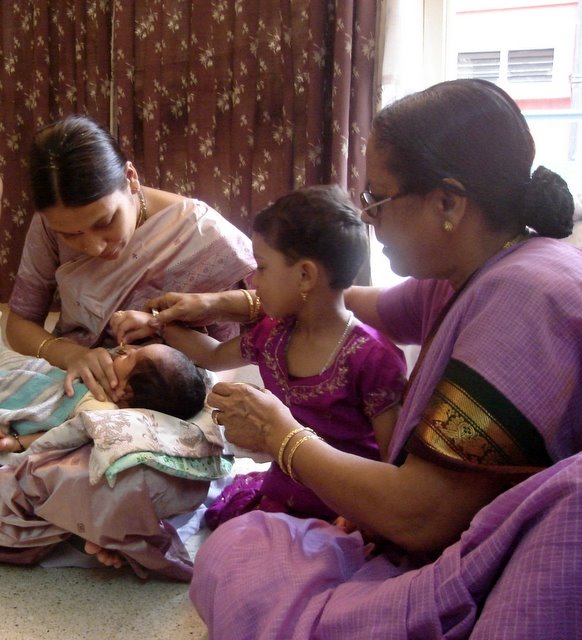
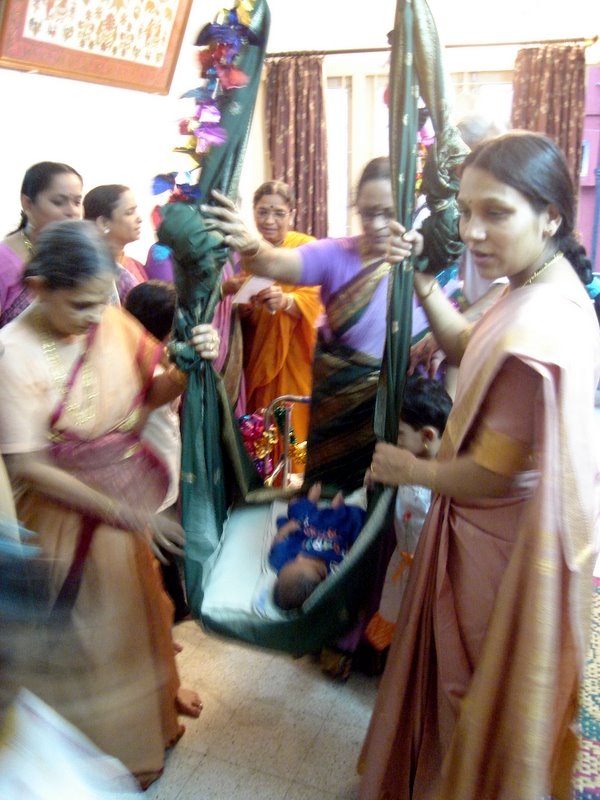
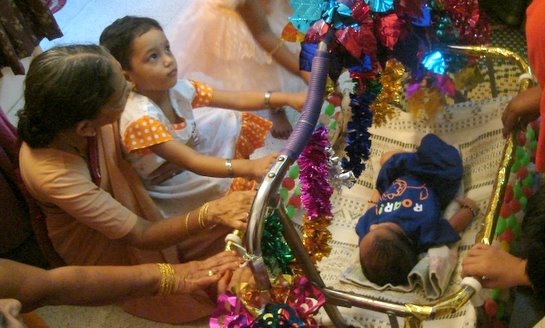
After this ritual is completed, each person scoops up a tiny bit of milk with one of the parents’ gold rings and gives a drop or two to the child (see photo). Later, the infant is placed in a cradle and everyone is invited to take a turn rocking the baby to sleep. As the child is being rocked, the women of the family gather to sing a lullaby (see photo, women singing in background.) Unlike the English lullaby in which the cradle is made to fall from a tree, this one tells the infant he or she is lying on the bedrock of the world, held up by the four Vedas and escorted by divine protectors.

After the child has been rocked by the adults in the tradition cradle made of a cloth tied to the ceiling, it is placed in a cradle on the floor and children are invited to join in and help put the child to sleep. The infant’s older sibling has been very much included in each phase of the ritual, sitting on her parents’ laps even during the most complex stages of the ritual, feeding milk to her brother and now rocking him to sleep.

Based on the astrological chart of the infant, this ceremony might also mark the first time that certain male relatives are permitted to see the child’s face, including even the father if the stars suggest he should not. In the case of the baby boy whose naming ritual I attended today, there had been no prohibitions against seeing his face earlier.

Meanwhile, it is at this ceremony that the child’s name is first made public. At this ritual, the child was already three weeks old, but nearly everyone was hearing the child’s name for the first time, including grandparents and his older sister. Here it is the child’s father who decides the name, perhaps in consultation with relatives. In this case, the father had still been weighing options up to the last minute. The name is announced – Madhav Simha and much discussion breaks out as relatives state the name to one another and comment on the choice. The strongest comments come from the infant’s four-year old sister, who greets this proposal a scowl and a vigorous shake of the head. No, she insists, to much laughter, his name is ‘Tamuru’ - the local term for ‘Brother.’

Wednesday, September 06, 2006

moving into a big pink building

Living in a ladies hostel is great, if you are a college freshman, or have very recently been one. Eating the hostel food is not great, no matter how dim one’s memories of home-cooked meals.

That said, I am grateful for the opportunity to learn about the lives of the first generation of young Indian women for whom a college education in engineering or computer science is the obvious choice, virtually regardless of their caste. But now that it is clear I will be here for a while more, the idea of having my own place began to make sense. Very good sense.

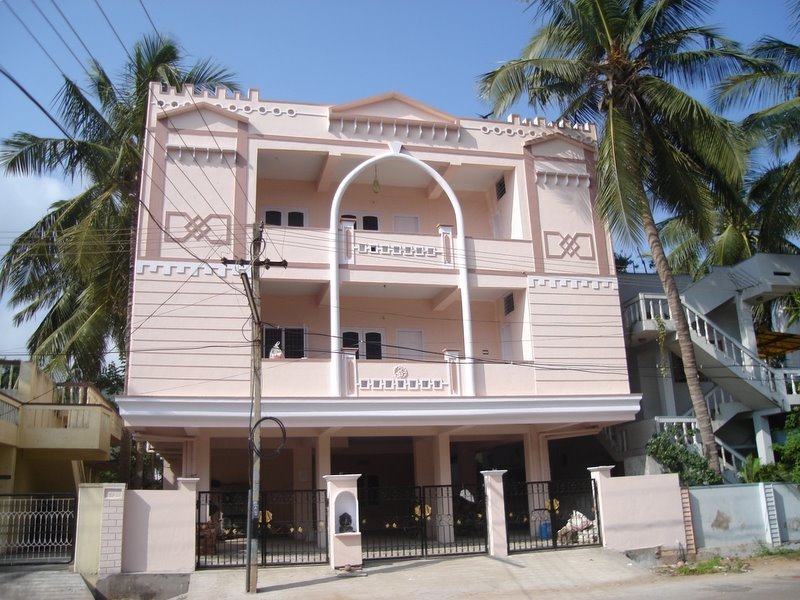
Last week, a ‘to let’ sign went up on a big pink building that has been under construction these past months, and within a few days, I had moved in. My new home is a brand new apartment with three bedrooms, three bathrooms, two balconies and excellent cross-breezes. I can see the sea from the rooftop. This is all serious overkill, definitely, but in fact it was the first apartment to come free within walking distance of my Sanskrit teacher’s home. And not only is it within walking distance, but literally across the street. From my front balcony I can look into my teacher’s front yard and see whether he is in or not. We signed a flexible short-term lease, and I will share this vast space with Sangeeta, who will be in and out of town as her research permits.

Did I mention the kitchen? Now to my Sanskrit classes I am adding lessons in cooking south Indian food, the one topic besides Sanskrit culture that I have seen my Sanskrit teacher generate real enthusiasm for. Recipes to follow…

Photos are of my workspace, of the view from my workspace out the door onto the front balcony and of the big pink building itself (our apartment is second floor in front).

Tuesday, September 05, 2006

“let us read” - on translating

My Sanskrit teacher Shastry Garu comments that when he was a boy in high school and eager to learn English, he used to go sometimes to hear Christian missionaries preach, since they were the only native English speakers in the area of Andhra Pradesh, in south India, where he lived. One very charismatic American preacher used to dance, weep and fall to the ground as he preached in English. Now, the missionaries always had a Telugu translator alongside them, and Shastry Garu notes that although he himself could not understand much of what the preacher said, he knew enough to tell that the translator understood even less. But when the American danced and threw his arms in the air as he preached in English, the translator too danced ecstatically as he spoke in Telugu. And when the preacher cried out and fell to the ground, so did the translator. This, Shastry Garu felt, was a valid translation, a translation of emotion. “The translator was not communicating the verbal argument. But the whole content of the speech was conveyed. It was a cogent display of inspiration and emotion,” Shastry Garu noted. “And it worked. It was a working translation.

“Translating each word into another language is not a valid translation. The meaning resides in the whole sentence, whole paragraph, sometimes in the book whole. “So when translating, Shastry Garu said, one should render entire sentences, not words. Translation should go from sentence to sentence. Even then, sometimes going from sentence to sentence is not enough. Sometimes you have to translate paragraph by paragraph to get the meaning into another language properly. Then too sometimes you have to concentrate on translating the emotion of a story. Sometimes that is the content. Changes will be necessitated by that. Then you are translating literature.

“You cannot go from word to word when you are translating. How does a language work? Each one has its own idiom. Idiomatic utterances are what convey meaning. A word alone does not. A word alone is not a valid unit of meaning…Let us read.”

The theory of translation that Shastry Garu is urging is deeply embedded in Sanskritic theories of language and of how meaning is generated. It is also very much at odds with the principles followed by many of the great scholars who translated Sanskrit texts into Tibetan, and of much translation by lesser beings of Tibetan into English. Including, to a far larger degree than Shastry Garu would accept, my own translation of the Sanghatasutra… I have some reflection to do.

Saturday, September 02, 2006

answering the call: cell phone use during rituals

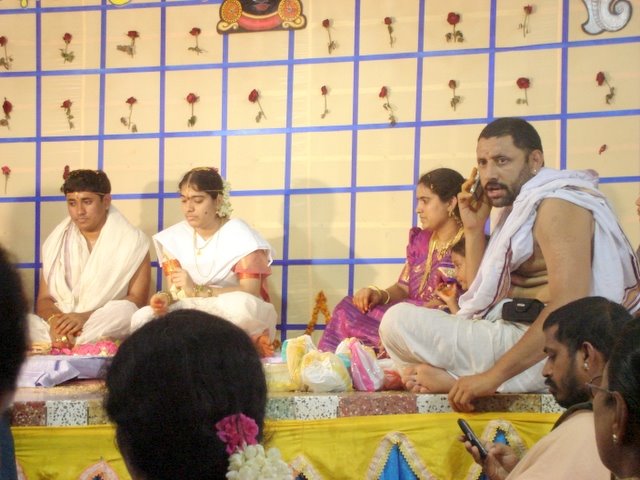
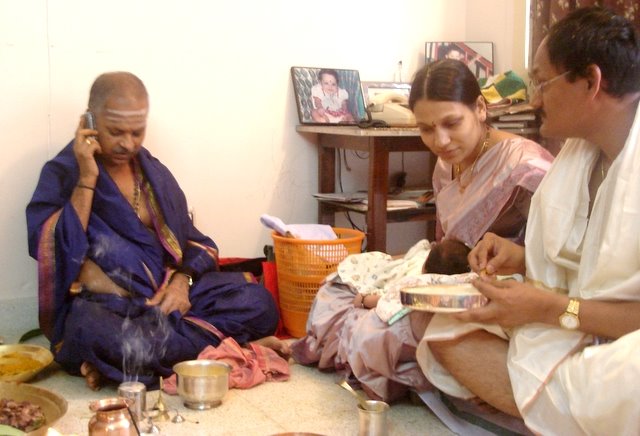
Social life just will not be put on hold, it seems, even during major rituals here. Over the last couple of weeks, I have attended three important rituals, marking the naming of a child and marriages. The families involved were fairly orthodox brahmins, and had chosen their ritual officiants (or purohita) with care, to ensure that all stages of the ritual were performed thoroughly and correctly. Nevertheless, when the ritual officiants’ cell phone rang during the ceremony, they did not hesitate to answer the call. At both weddings I attended, the grooms also took calls on their cell phones as the wedding ceremony went on, but sadly not while my camera was at hand.

If the use of cell phones is any indication, these life-cycle rituals do not interrupt ordinary life, but absorb it, even as they punctuate and transform it. At no time did those talking on their phones while they participated in the ritual appear embarrassed or offer an apology. Nor did I see anyone exchange disapproving glances. Indeed, the only people who seemed to find this noteworthy were my friends Sangeeta, Ma’ayan and I, all three of us students of Indian religions, with all the apparently false assumptions about solemnity of rituals that entails.

The accompanying photos are taken at a wedding and at a naming ceremony, hosted by two different families in two different cities. In each case, the person on the phone is a central participant in the ritual.

Tuesday, August 08, 2006

hitting the road

So August is a big time for weddings here (yes, those would be ‘monsoon weddings’) and my teacher has invited Sangeeta and me to attend one near his native village, about half a day’s journey from here. The village is in the general area of Amaravati, one of the earliest remaining Buddhist stupas, and the site of a Kalachakra initiation for world peace by His Holiness the Dalai Lama earlier this year. After the weddings, we will visit Amaravati, and another monastery carved into a mountain, in which the great Buddhist logician Dignāga lived.

Expect to be back in Visakhapatnam, and back online, on the 14th or 15th.

Friday, August 04, 2006

monsoon or cyclone?

The weather here defies my clumsy attempts to understand my environment. Until two days ago, rain has been light, infrequent. Laundry dries within hours. My umbrella spends most of its time in my bag. But this is August already, and we should be halfway into the monsoon season. I ask my teacher, ‘Is this actually the monsoon? Has it come yet or not?’ ‘What do you understand by monsoon?’ he asks. ‘It is raining.’ I decide to be satisfied with that, and to stop grasping about for some ‘actual monsoon,’ as if such a thing truly existed. And when we finally get rains that do finally satisfy my pre-conceived notion of ‘monsoon,’ it turns out to have been a cyclone.

What I happily labeled ‘real monsoon weather’ kicked in about two days ago. It poured all day yesterday. And most of the day before these were heavy rains that did not seem sustainable for very long, and yet that lasted hour after hour after hour. The kind of rain that would have set Noah a-thinking. Then the winds picked up in the evening. We slept to the sound of doors banging and woke up to realize that the worst of it had passed through overnight. Massive healthy branches now littered the roads.

The power is out across the city, no doubt with many power lines cut. But no road crews need to be sent out to clear the fallen trees. Instead, already within an hour of sunrise, the city’s poor are out scouring the streets for firewood. The park across the street from our house yielded an ample supply of fallen branches, and very quickly small groups of people are at work with scythes and an axe, breaking the fallen trees into manageable parts. Twigs and logs are sorted into piles, as men and woman both work with good cheer. By lunch-time, women are on their way home with large bundles of free firewood on their heads. The cyclone has yielded them, quite literally, a windfall.

To me, this downpour that is not ‘the monsoon’ but ‘a cyclone’ has yielded only a small reminder of how arbitrary the act of labeling can be, especially when it comes to weather. Still, I catch myself wondering what category this cyclone would have been considered back home…

Tuesday, August 01, 2006

anniversary of my ordination


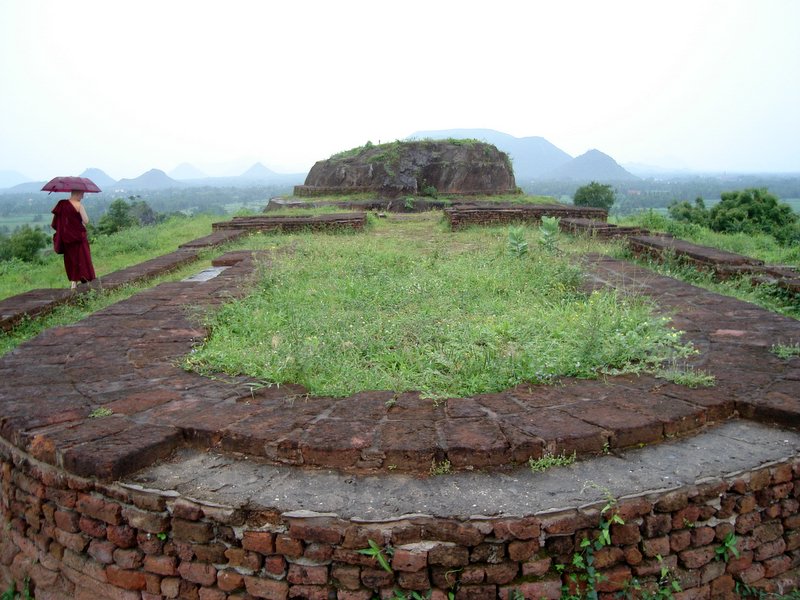
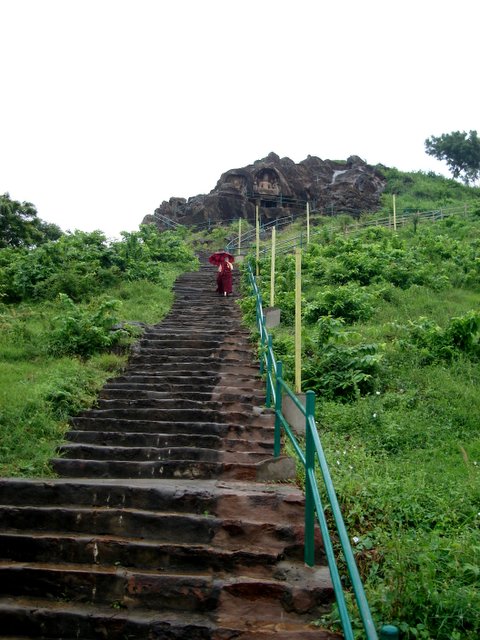
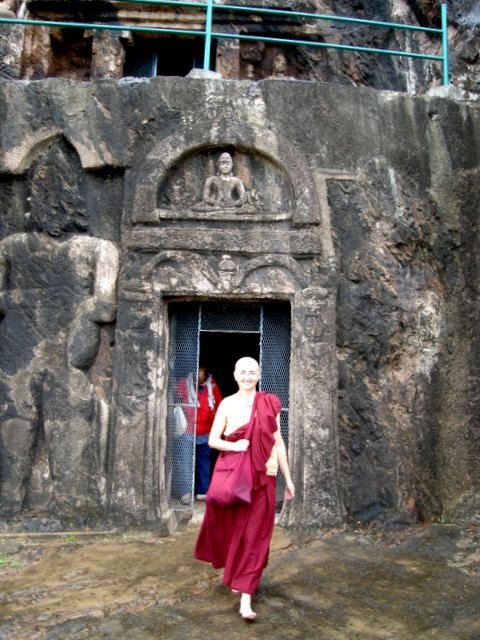
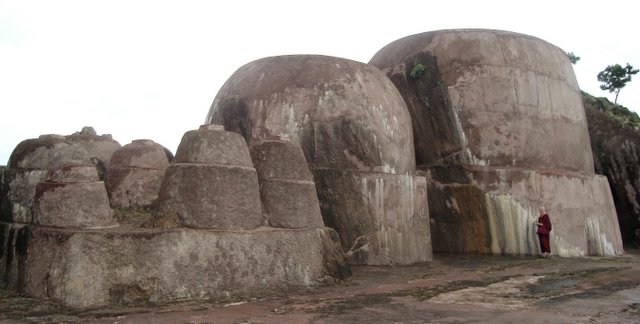
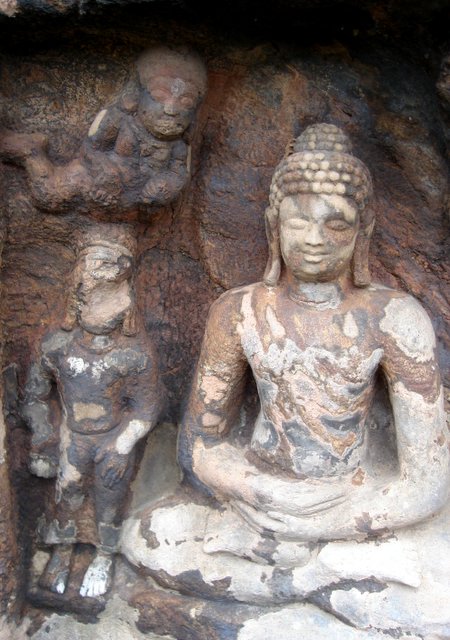
Today is the seventh anniversary of my ordination. Although it seems safe to say I am the only Buddhist monastic for many miles around, I managed to spend the day in what was clearly a thriving monastery - many centuries ago. As you can see, it is the rainy season here. Here are some photos from that visit, with more text to come...


Monday, July 31, 2006

“let us read” - on commentary

Very often as we read, my teacher, Prabhakara Shastry (aka Shastry Garu) will take the opportunity to expand on a point he considers important. This discussion may take just a moment, or may equally well take up much of our reading session. But once Shastry Garu has said what he wants to say, he usually pauses for a moment thinking, and then says, “Let us read.” Then we resume our reading of the text. For this reason, from time to time I will be posting bits of those comments under the heading, “let us read.”

We are each reading a different edition of the same text (the Sanskrit Vinayavastu), and today we come across a passage where the editor of one edition has placed a dan.d.a (a kind of period used to punctuate Sanskrit texts) in a certain spot, while the other has not. Shastry Garu observes, “This dan.d.a is a commentary. Putting a dan.d.a is making a commentary. Whoever has edited the book has commented on it. If you copy all the words of a book by hand, thinking you have not changed a thing, that is also a commentary. Any book that comes to you in any way, you are commenting on. Even just carrying a book from place to place is a commentary. Some books you may wrap carefully in cloth and carry like that. Others you just grab and go. When you carry it carefully, you are commenting that this is a very important text, the other is not. You cannot touch a book without commenting on it… Let us read.”

life in a ‘ladies hostel’ - hazing, indian style

In India nowadays, a form of hazing called ‘ragging’ is an integral part of college life for all incoming students, not just those seeking to join a fraternity or sorority. All upperclassman have the right to rag on all freshmen in their schools. Some of the senior girls in the hostel I stay in have decided to ‘rag’ some of the incoming freshmen, and for days I am privy to all their planning and plotting. One night, as I walk past the dining area, I see that the ragging is in session.

Ragging, as it turns out, is not merely a way to wield one’s power over those socially weaker (though of course it may be that too), but in fact involves both ragger and ragged in a set of social commitments that will last throughout their college careers. Once the junior has successively passed through the ragging, the senior will tell them that they can come to them with questions or problems while they are at college, and if any other senior students attempt to rag the junior, the seniors have an obligation to head them off. In essence, the younger must demonstrate their willingness to show respect and humility towards their elders, and the elders must protect and take care of them as they are able. Ragging continues until both sides accept these roles in relation to each other.

Seniority is based here not on social, economic or caste position, but simply on one’s year in college. At least in theory. Once a senior is satisfied that the junior has accepted the terms of the relationship as they see fit, a kind of friendship may begin to take shape.

In the hostel I am living in, the upperclassmen have chosen to rag the freshmen in the hostel because one of them have behaved in a way that seemed arrogant towards the seniors. How did this arrogance manifest? Mainly in giving flip answers to polite questions, as far as I could tell.

This ragging continues from the first day of classes until a ceremony called ‘Freshers,’ in which the upperclassmen stage a night of entertainment for the freshman, usually a few months into the first year. After ‘Freshers,’ all ragging stops. It may stop earlier, if the seniors are satisfied that the junior students are appropriately respectful towards their elders. My friend Sharada explains to me that once the freshman have satisfied them with their handling of the ragging, if any other girls want to rag them, they will say, “No, please don’t. We have ragged them and they answered properly.”’ If the upperclassman are still not satisfied by the time ‘freshers’ is held, what happens, I ask? Are there any repercussions after the day of Freshers? ‘We are their seniors,’ Sharada explains. ‘So there will definitely come a time when they need our assistance or guidance, and we will not give it to them.’ Effectively, if the junior students do not agree to their side of the relationships by showing respect to their elders, the elders will not take them under their wings.

At least this is how it is meant to work in the college that my friend in the hostel attends. Engineering colleges are notoriously bad for ragging, and there it has gone as far as some of the worst fraternity hazing incidents. A couple of years ago, a boy died jumping off a roof when given the choice between jumping and walking barefoot over glass. Since then, ragging is banned and police will come to campus during the first months of the year in an effort to prevent it. It continues of course, though perhaps with a bit less venom. My friend Sharada at once laments the harshness of ragging at engineering schools and justifies its use in her own, albeit in a milder form.

The night of ragging at our hostel consisted in making freshman talk about themselves and their hobbies and then meet challenges. One freshman cites singing as her hobby, and is asked to song for the group. One who names watching football as her hobby is asked to name all the members of India’s national team. She is unable to do so, and is told to have the list memorized for the following day. Those who seem submissive are let off lightly. The arrogant girl leaves with a list of eight tasks.

The ragging would have continued the following day, but the arrogant girl calls her parents and have them call and complain to the manager of the hostel, who is also effectively its RA. She puts a firm stop to the ragging. The upperclassman have been outmaneuvered.

I return from Hyderabad a few weeks after this took place, and in that short time, I can see that the freshman who handled themselves satisfactorily that first night have formed bonds with some of the upperclassman. Friendships are in the offing.

The arrogant girl whose parents called to stop the ragging eats alone with a couple of other freshmen who had taken her side. They make little eye contact with their housemates.

Saturday, July 29, 2006

two discoveries in hyderabad: lost and finds

In the city of Hyderabad – or Hydro as Sangeeta calls it – I make two discoveries of note. It is in this state of Andhra Pradesh that His Holiness the Dalai Lama recently conferred the Kalachakra initiation at Amaravati, a major Buddhist site whose importance seems to have peaked some 2,000 years ago. In my attempts to learn more about the history of Buddhism in Andhra, I learn that the state is full of old monasteries, cave complexes and stupa sites, in various stages of archaeological excavation. Several such sites are in the vicinity of Visakhapatnam, and I plan to visit them soon.

The other major discovery I make in Hyderabad is pretty far from this first. In many ways. Though I went to Hyderabad full of plans to use the time to deepen my study of Sanskrit grammar, when I actually arrived I rapidly discovered that I urgently needed some rest. I did do some Sanskrit, mainly to keep Sangeeta company while she did hers, but mostly …how to put it? I rested. On Sangeeta’s couch. In front of Sangeeta’s TV. It turns out that Sangeeta had the entire first season of Lost, a show I had never seen. Within the eight days I was in Hyderabad, Sangeeta and I watched the entire first season together. It never occurred to me that I missed American television. In fact, I had lived in a house without television for most of the last seven eight years or so. Yet the show’s basic premise struck me as eerily familiar – that one is dropped into society with people one does not know, in an environment operating on principles that continually challenge one’s assumptions and which one must continually re-assess … well, that is not too bad a model of the experience of trying to figure out how to manage life and get research done here. But watching Lost, someone actually gives you the back-story. And somehow, there is great comfort in the hope that we viewers actually will come to understand the principles of the reality operating on the island --a hope I cannot always afford to indulge in my own life. In the meantime, from the scene where they first realize Sun speaks English, Hurley has given me new language for responding appreciatively and with poise to the surprises life here can throw: “Didn’t see that coming.”

So maybe it was not just about getting some needed downtime, or pining for American culture. But in any case, we are already plotting ways to get a copy of the second season… and friends, I know you are all a full season ahead, but please do not spoil any of the surprises to come. Especially if things do not become more clear!

‘tribals’ take a train

My Sanskrit teacher has to go to Hyderabad for a week to attend to some family business. With class, there is no reason to stay in Vizag, and I seize the chance to spend some time with Sangeeta in the much bigger and more cosmopolitan town of Hyderabad. I take the overnight train there with my teacher, who will not hear of taking an upper class berth. We travel ‘sleeper class’ and have for traveling companions four women who have never been on a train before, or on a bus, or in a town. They are from a ‘tribal area’ and have been selected to travel to Hyderabad for six months of training to allow enable them maintain a solar electrical facility that is being donated to their village.

Their village is in an isolated patch of the mountains in Orissa, a neighboring state and has no electricity or phone services. They share no language with anyone but their translator, and I seem to be no stranger to them than everything and everyone else in their new environment. I find this quite a relief. They were selected because the four of them had banded together and started a ‘self-help society’ and received funding to help them make and market local crafts. They were enterprising, alert and obviously bright women, ranging in age from about late 20s on up. Apparently it took a month of convincing to get them to leave their village, their families, their terra cognita, their everything. But here they were, about to start what clearly would be the experience of a lifetime. They were a bit startled when the train first pulled out of the station, but on the whole struck me as remarkably self-possessed and frankly less awed by their new surroundings than most foreign tourist might be.

I have no doubts that the village’s solar electricity will be running well for many years to come.

Wednesday, July 26, 2006

five blocks from a beach i do not visit

For the first solid month of my time in Visakhapatnam, I have done virtually nothing but Sanskrit. Once I have had breakfast at the hostel, I go straight to my teacher’s house and begin the day of studying. He has given me the use of one room in his house that has a separate entrance. I arrive and begin translating what we have read the previous day until he arrives and we begin to read more. Lunch is served at noon, and we usually wrap up the morning reading at about 1 pm. I cross the street to the hostel where meals are served, and hope there are still vegetables left. Lunch is unvaryingly rice, dal, rasam, some vegetable dish and yogurt. If I arrive too late, I may miss the vegetable dish. After lunch there is a break which I use to write up the morning translation, and to rest.

By late afternoon, we are back at it. Before we move on to a new section of the text, I am required to read aloud the Sanskrit that we have just read together, indicating with my inflection that I have understood the meaning, and being prepared to identify any forms and vocabulary as Shastry Garu chooses to grill me on. There are breaks for coffee and for Shastry Garu to collect the fresh drinking water that is pumped by the municipality only for an hour in the evenings. At about 10:30 in the evening, we wind down. When we read much later than that, as we often do, my teacher will walk me back the two blocks to where I am staying, for safety. Shastry Garu is 70 years old, and I can only hope to have that sort of stamina when I reach his age. And the extraordinary generosity with my time.

Days pass like this, then a week, then a month. We have not taken a single day off. The house I am staying in is five blocks from the beach, a long sandy stretch on the Bay of Bengal. Though this is just an easy five minutes’ walk away, and I know a little physical walking exercise would do me good, I have not seen the sea even once during this month. After the two months of enforced leisure time in Pune, the time Shastry Garu offers is far too precious for me to even think of a stroll on the beach.

Friday, July 21, 2006

blogging after 7/11

I write this blog entry knowing I may be unable to post it. The Indian government has blocked access to blogspot.com, which hosts this little blog, as well as quite a few other sites. It did so – ostensibly – in the belief that blogs may have been used blogs by the terrorists in orchestrating the devastating attack on Mumbai (Bombay) two weeks ago. Hundreds of people died in the blasts that targeted commuter trains during evening rush hour. One by one, a series of bombs planted in seven different trains, taking the lives of hundreds of workers packed into the cars that were bringing them home after a long day’s work in the center of the city.

That horrific attack took place on July 11, earning it the name 7/11. Like 9/11, the attack is thought to have been engineered by extremist Muslim groups. Like New York, Mumbai is the financial capital of this country. But the issues at stake in responding to a terrorist attack are far more volatile here in India than they had been in the States, the major issue being the possibility of ‘communal violence.’ Communal violence is used here as a catch-all phrase referring to inter-caste fighting, fighting between ethnic or racial groups and, as most relevant in this instance, violence perpetrated by followers of one religious group against another. For days after the 7/11 attack, while newspapers were quoting unnamed government sources pointing to a Muslim group called Lashkar as the authors of the ruthless attack, the government itself officially declined to point fingers, saying not all evidence was in as yet. The reason? Fear that violent reprisals would be taken against Muslims across India. As the nation’s largest ‘minority,’ Muslims form a substantial portion of the Indian population, living and working right alongside non-Muslim Indians in all spheres of public life.

Concern that anti-Muslim rioting could break out has tempered reactions since 7/11, and such concerns are eminently well-founded. Just days before the 7/11 attack, supporters of a right-wing Hindu group Shiv Sena had gone on a rampage in Mumbai after the desecration of a statue of the wife of one of its heroes, overturning cars and ransacking businesses. It is worth noting that blogs are not the only websites that Internet users within India have been unable to access since 7/11. A long list of pro-Hindu sites, including some extremist and rather incendiary, were likewise banned, as the Indian government has struggled to avert the feared ‘communal violence.’

Unlike the flag-waving., ‘these-colors-don’t-run’ sentiments aired on American networks after 9/11, Indian TV stations are broadcasting appeals for tolerance, with personal statements from a long series of Bollywood film stars, cricket players and other popular figures.

So far, people seem to be listening.

Sunday, July 16, 2006

sangeeta comes to vizag

My room in the ‘ladies hostel’ in Vizag is small, but has space enough for two narrow twin beds. Every other room of this size has two, or even three girls living in it. I have warded off the attempts by the landlady of this off-campus dorm housing to install a roommate in my room with the promise that my friend Sangeeta would be coming to Vizag and would stay there with me. I finally make good on that promise. We travel back from Hyderabad together, after my restful week there, and the very morning we arrive, begin working with the professor on Sanskrit.

She will be here for six weeks. This is very good news for me. The work I’ve done on my own here has been enough to sustain me, but Sangeeta’s company makes all aspects of life here that much richer. We each sit in the room while the other reads with our teacher, working on our own translation of following the other’s reading as time allows. We grapple together with the challenges of life here – getting our laundry dry in this monsoon weather, keeping the mosquitoes away and managing to stay healthy on hostel food. At the end of each day, days that are long and full of our Sanskrit texts, we hold ‘story hour,’ trading tales from our respective texts.